

- Solid State Battery & Electrolyte
- Mesoscale Architectures
- Nano- & Micro-structure Degradation
- Interfaces & Interphases
- Synthesis / Enabling Platforms
- Precision Nanostructures / Nanopores
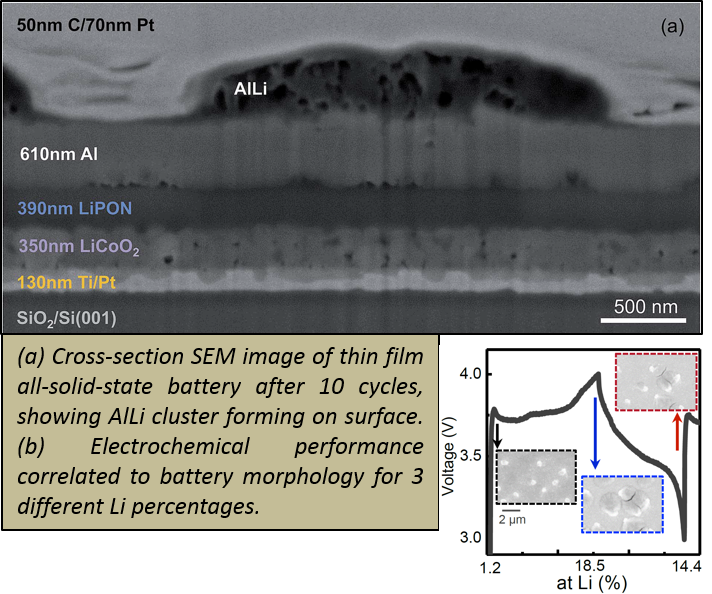
Predicting Dynamic Potential Distributions and Space-Charge Layers in Solid State Battery Systems
Scientific Achievement
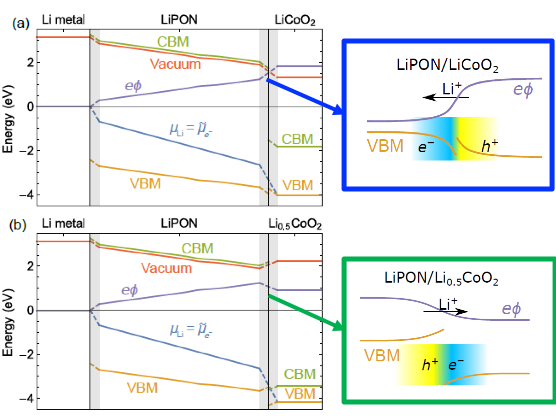
- Established a theoretical framework to predict interface potential profiles from thermodynamic driving forces, defect formation energies, and electronic band alignments.
- Predicted that e- and Li+ transfer at LiPON/LixCoO2 interface depends on cathode state-of-charge, leading to field reversal from x=0.5 to x=1 and an explanation for conflicting experimental results.
Significance and Impact
Theoretical approach integrates behavior of electron-related voltages and ion-related chemical potentials in battery systems as transported ions alter electrode materials, changing interfacial space charge fields that modulate both ion and electron transport.
Research Details
- Chemical potential changes as lithiation proceeds have profound consequences for charge transport.
- Differing x=[Li] may explain different Li+ transport direction at LiPON/LixCoO2 inferred from experiment.
- Results suggest preferred solid electrolyte materials to increase discharge power.
References
- A.Michael W. Swift and Yue Qi, “First-principles prediction of potentials and space-charge layers in all-solid-state batteries”, Phys Rev Letters (in revision).
Summary
Solid state batteries, differentiated by their use of solid electrolytes, offer advantages in safety (no flammable liquid electrolyte) and in the 3D structures that can be achieved. When fabricated in thin film form, a wide variety of battery architectures and form factors are possible. As example, battery materials can be configured in 3D interpenetrating-electrode architectures that promise simultaneous energy-power performance, along with long cycle life and safety. But while thin film fabrication enables high power at high energy, it also places a premium on understanding and control of solid state electrochemical interfaces (e.g., electrode/solid-electrolyte)
This raises a profound scientific challenge to understand the coupled behavior of ions and electrons at solid state electrochemical interfaces. The battery community has long studied ion transport in liquid electrolyte systems and battery electrodes, with electrons playing a secondary role. At the same time the solid state electronics community has investigated many aspects of electron transport and interfaces, but in the absence of mobile ions. Solid state battery operation relies on coupled, interdependent ion and electron behavior, posing a conceptual and theoretical challenge to address in a self-consistent fashion. As a heterojunction system, solid state batteries provide a landscape of energy bands and barriers that affect not only electron transport but also the ion transport on which battery function is based. However, the intrinsic functionality of charge/discharge alters the electrode materials themselves, e.g. through lithiation/delithiation, and when the materials change their energy bands and barriers change as well - hence the need to address ion and electron behavior together in a coherent framework.
This highlight presents a fully first-principles-informed model of potential profiles in a model solid state battery system, Li-anode/LiPON-solid-electrolyte/LixCoO2-cathode. The profiles account for thermodynamic driving forces, defect formation energies, and electronic band alignments. The approach integrates behavior of electron-related voltages and ion-related chemical potentials and shows that - contrary to purely electronic systems - the electronic Fermi level changes to drive battery operation. An unexpected prediction is that the direction of the electric field driving Li transport at the LiPON/LixCoO2 interface reverses as the cathode state-of-charge x changes from 0.5 to 1.0. The changing direction of Li flow, dependent on x, may explain conflicting conclusions drawn from experiments. These observations suggest several ways that could be effective in reducing interface resistance in solid state batteries.
Acknowledgements
This work was supported by the NEES-EFRC.
High Performance Conformal 3D Battery Architectures for Solid State Storage
Scientific Achievement
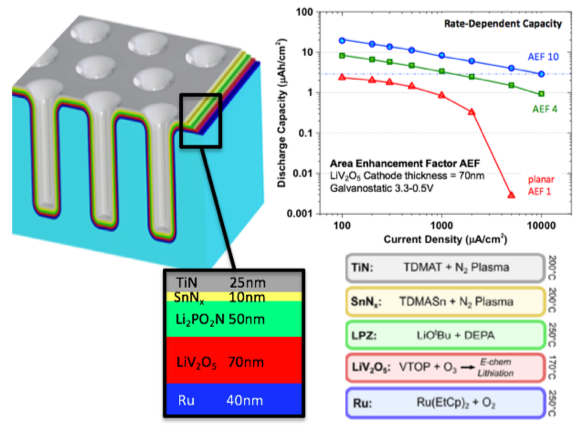
Simultaneous high power and high energy have been demonstrated in a solid state 3D battery architecture formed from high aspect ratio features conformally coated by ALD electrode, electrolyte, and current collector layers.
Significance and Impact
Controlled 3D structuring of solid state battery architectures provides distinct power and energy advantages compared to planar counterparts, motivating new directions in mesoscale design and synthesis and expanding the purview of solid state storage.
Research Details
- All active battery layers were formed by highly conformal ALD processes over silicon microstructures with aspect ratios up to 10:1.
- Areal energy density benefits from larger surface area exposed in 3D structures.
- Power enhancement is achieved through thin electrode layers, enabling fast ion access.
References
- A. Pearse, T. Schmitt, E. Sahadeo, D.M. Stewart, A. Kozen, K. Gerasopoulos, A.A. Talin, S.B. Lee, G.W. Rubloff, K.E. Gregorczyk, “Three-Dimensional Solid-State Lithium-Ion Batteries Fabricated by Conformal V apor-Phase Chemistry”, ACS Nano 12, 4296-4294 (2018)
Summary
NEES scientists have for some time recognized the promise of precision nanostructures to achieve simultaneously high power and high energy through (1) thin ion storage/transport layers that enable fast ion transport through the entire thickness of material and (2) fast electron transport layers specifically positioned in intimate contact with the ion layers. Thin film processes enable such arrangements even for configurations having high aspect ratios (height/width), providing advantages for battery components formed in this way rather than using today’s particle composite electrodes.
Solid state batteries, differentiated by their use of solid electrolytes, offer advantages in safety (no flammable liquid electrolyte) and in the 3D structures that can be achieved. A long-sought goal has been a 3D solid state battery which realizes interpenetrating electrodes separated by conformal electrolyte and meets the design conditions for ions and electrons stated above.
NEES researchers have now achieved this goal. Building on prior expertise in conformal ALD deposition of thin cathode and anode electrode materials, they then developed conformal ALD processes for LiPON solid electrolyte. Pores were etched into Si wafers to depths up to 10X their widths to form a template, after which very thin ALD layers were added: 40nm Ru current collector, 70nm LiV2O5 cathode, 50nm Li2PO2N solid electrolyte, 10nm SnN anode, and 25nm TiN current collector, with cathode and anode geometry reflecting the interpenetrating architecture.
Arrays of these nano/micro batteries present excellent performance, particularly at aspect ratios ~10 where the 3D benefits are most apparent. With ~10X the electrode area cf planar counterparts, energy density at low power is enhanced by a similar factor ~10X. At high power (10mA/cm2) the 3D configuration retains energy capacity far better than the planar configuration, since local current density and power in the 3D case is substantially reduced. For expected enhancements of dimensions and materials, projected performance of the 3D interpenetrating architecture will supersede everything available today in solid state storage.
Acknowledgements
This work was supported by the NEES-EFRC.
Conformal Thin-Film Solid Electrolyte Synthesis Enabled by Atomic Layer Deposition (ALD)
Scientific Achievement
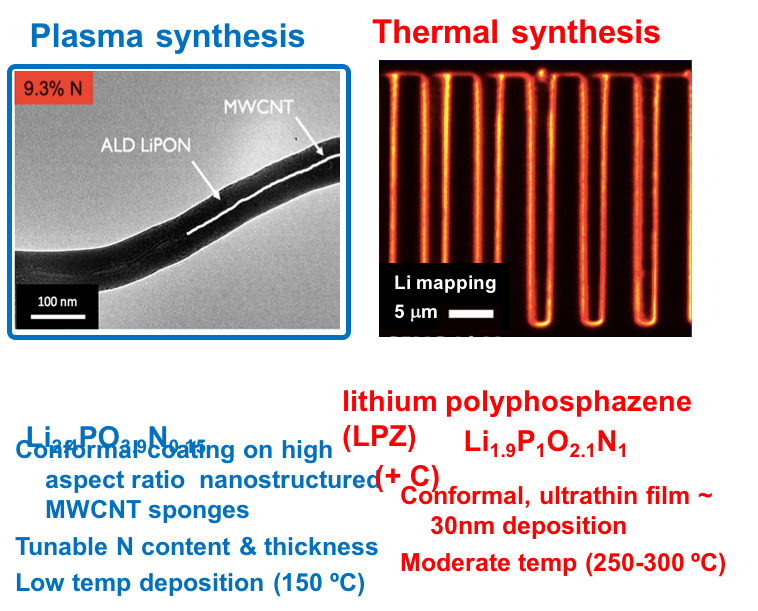
We developed two ALD synthesis procedures to achieve tunable, conformal, ultrathin-film deposition for lithium phosphorus oxynitride (LiPON) solid electrolyte, demonstrating its electrochemical functionality with different substrate materials and geometries.
Significance and Impact
ALD provides ultrathin conformal solid electrolytes for
- Electrode protection layers (plasma LiPON).
- 3D solid state batteries (thermal LPZ).
Research Details
- Plasma ALD LiPON (4-precursor process) grows at low temperatures (150°C) compatible with Li and Na metal anodes.
- Thermal ALD LPZ grown by 2-precursor process (Li tert-butoxide & diethyl phosphoramidate) between 250-300 ºC achieves ionic conductivity ~6 × 10⁻⁷ S/cm at 35 °C and is stable over 0.0-5.3 V vs. Li/Li+, with lower charge transfer resistance than plasma LiPON.
References
NEES ALD LiPON synthesis references- A.J. Pearse, T.E. Schmitt, E.J. Fuller, F. El-Gabaly, C-F. Lin, K. Gerasopoulos, A.C. Kozen, A.A. Talin, G.W. Rubloff, K.E. Gregorczyk, “Nanoscale Solid State Batteries Enabled by Thermal ALD of a LiPON Solid State Electrolyte”, Chemistry of Materials, 2017, 29(8), pp 3740-3753. Doi 10.1021/acs.chemmater.7b00805.
- A.C. Kozen, A.J. Pearse, C-F. Lin, M. Noked, G.W. Rubloff, “Atomic Layer Deposition of the Solid Electrolyte LiPON”, Chemistry of Materials, 2015, 27(15), pp 5324-5331. Doi 10.1021/acs.chemmater.5b01654.
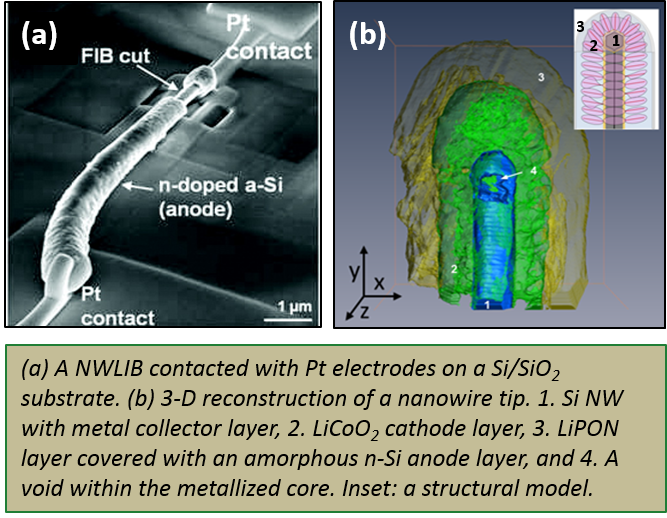
- A.A. Talin, D. Ruzmetov, A. Kolmakov, K. Mckelvey, N. Ware, F. El Gabaly, B. Dunn, H.S. White, ”Fabrication, Testing, and Simulation of All-Solid-State 3D Li-ion Batteries”, ACS Appl. Mater. Interfaces, 2016, 8(47), pp 32385-32391. Doi 10.1021/acsami.6b12244.
- V.P. Oleshko, T. Lam, D. Ruzmetov, P. Haney, H.J. Lezec, A.V. Davydov, S. Krylyuk, J. Cumings, A.A. Talin, ”Miniature All-Solid-State Heterostructure Nanowire Li-ion Batteries as a Tool for Engineering and Structural Diagnostics of Nanoscale Electrochemical Processes”, Nanoscale, 2014, 6(20), pp 11756-11768. Doi 10.1039/c4nr01666a.
Summary
The ability to synthesize uniform, conformal thin-film solid state electrolytes is a major challenge in evolving from the planar 2D geometry to the more complex 3D architectural topology in Li-ion solid state battery (SSB) design. Here, NEES research team invested in the development of vapor phase chemistry – specifically atomic layer deposition (ALD) techniques - to create LiPON-like solid electrolytes with precision control of growth at molecular (sub-nm) scale. By enabling battery structures with high aspect ratios, substantial benefits accrue in power and energy densities per areal footprint.
This work represents a substantial step forward from our previous studies (ref below), which revealed limitations in sputter deposition techniques for 3D SSBs, e.g. electrical shorts and inhomogeneous current distributions. We consequently developed two ALD synthesis procedures for LiPON solid electrolytes family: (1) low temperature plasma growth suitable and compatible with Li and Na metal anodes to provide ultrathin protection layers; and (2) a thermal ALD process for LiPON-like material (LPZ) with notable advantages that has enabled our proof of concept for the first 3D conformal Li ion solid state battery.
We are submitting a second highlight slide on the plasma synthesized LiPON for electrode protection layers. The 3D ALD Li-ion SSB publication result was just submitted to the peer-review process and the accompanying highlight will be turned in to the DOE BES upon acceptance.
Acknowledgements
This work was initiated and primarily supported and carried out by EFRC-NEES at UMD.
Mitigating Degradation with Nanoscale Precision: Ultrathin ALD LiPON for Electrode Protection Layers
Scientific Achievement
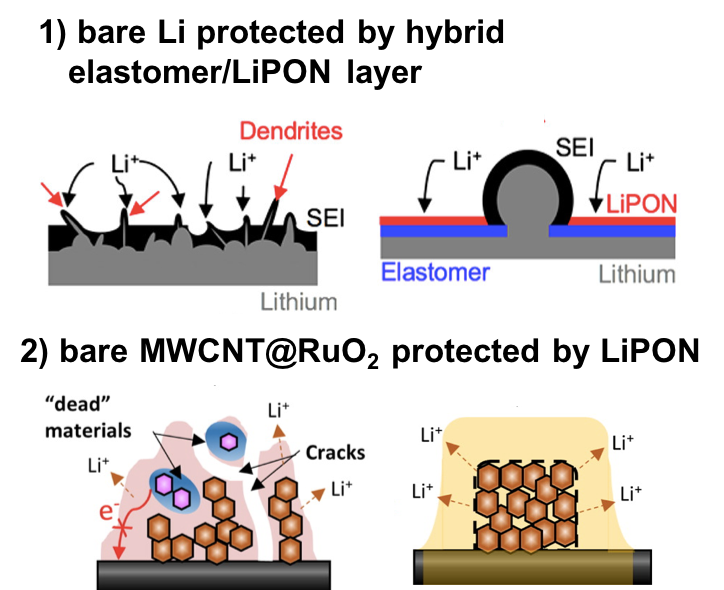
Different model systems were employed to assess the efficacy of conformal, ultrathin (∼15-20nm) LiPON as protection layers to retain capacity of high energy density electrode during lithiation/delithiation.
Significance and Impact
Nanoscale ion conducting, electrically insulating layers function as well-controlled solid electrolyte interphases to mitigate capacity degradation during cycling.
Research Details
- Li metal anode protection: hybrid organic (elastomer) and inorganic (LiPON) layers deliver mechanical & chemical protection respectively and suppress dendrite formation up to 2 mA/cm2 over 100 Li plating/stripping cycles.
- Conversion electrode protection: LiPON provides mechanical & electrochemical stability in model 3D core-shell nanostructures consisting of multiwall carbon nanotubes coated with RuO2.
References
NEES ALD LiPON as protective layers references- A.C. Kozen, C-F. Lin, O. Zhao, S.B. Lee, G.W. Rubloff, M. Noked, “Stablization of Li Metal Anodes by Hybrid Artificial Solid Electrolyte Interphase”, Chem. Mater. 2017, in print. Doi 10.1021/acs.chemmater.7b01496.
- C-F. Lin, M. Noked, A.C. Kozen, C. Liu, O. Zhao, K. Gregorczyk, L. Hu, S.B. Lee, G.W. Rubloff, “Solid Electrolyte LiPON as a Protective Nanocladding Layer for 3D Hihg-capacity Conversion Electrodes”, ACS Nano, 2016, 10(2), pp 2693-2701. Doi 10.1021/acsnano.5b07757.
- X. Han, Y. Gong, K. Fu, X. He, G.T. Hitz, J. Dai, A. Pearse, B. Liu, H Wang, G.W. Rubloff, Y. Mo, V. Thangadurai, E.D. Wachsman, L. Hu, “Negating Interfacial Impedance in Garnet-based Solid-state Li Metal Batteries”, Nat Mater, 2017, 16, pp 572-579. Doi 10.1038/nmat4821.
- C-F. Lin, A.C. Kozen, M. Noked, C. Liu, G.W. Rubloff, “ALD Protection of Li-metal Anode Surfaces – Quantifying and Preventing Chemical and Electrochemical Corrosion in Organic Solvent”, Adv Mater Interfaces, 2016, 3(21), pp 1600426. Doi 10.1002/admi.201600426.
- W. Luo, C-F. Lin, O. Zhao, M. Noked, Y. Zhang, G.W. Rubloff, L. Hu, “Ultrathin Surface Coating Enables the Stable Sodium Metal Anode”, Adv Energy Mater, 2016, 7(2), pp 1601526-6. Doi 10.1002/aenm.201601526.
Summary
This work capitalizes on NEES' capability at University of Maryland in developing ultrathin, conformal ALD films and integrating them into storage structures. Here we illustrate in two quite different model systems the utilization of this capability for forming protection layers for high energy electrode materials, based on plasma-based ALD LiPON as a Li ion permeable solid electrolyte, which is electronically insulating. Such protection layers significantly enhance capacity retention during charge/discharge cycling, now shown in a number of battery chemistries.
In the hybrid protection approach on the Li metal anode, we first produced an elastomer layer ( ~800 nm) electrochemically to provide mechanical flexibility, followed by an ALD LiPON layer (∼15 nm) resistant to chemical/electrochemical attack. This also suppressed dendrite growth, even under favorable conditions (2 mA/cm2) for dendrite formation, over 100 plating/stripping cycles. This application requires the low temperatures (below 180C Li melting point) available in the plasma LiPON process.
In the 3D MWCNT@RuO2@LiPON conversion electrode system, the LiPON protection layer was effective in capacity retention despite the thorough reorganization of atoms and chemical bonds that accompanies the RuO2 conversion reaction (to Ru metal and Li2O) and its reverse reaction. We hypothesized that the LiPON layer (~17nm) provides a physical/mechanical constrain to the electrode material.
Acknowledgements
This work was supported by NEES & performed at UMD.
Thin Film Solid State Battery Enables Analog Memory for Neuromorphic Computing
Scientific Achievement
Operation of thin film solid state batteries has been used to control ion content in a transistor channel region, thereby modulating its source-drain electronic conductance and providing voltage-controlled nonvolatile memory functionality.
Significance and Impact
A battery-like ion-configurable electrode serving as a transistor channel represents a new paradigm for analog memory devices, which are central to neuromorphic computing and its machine learning applications.
Research Details
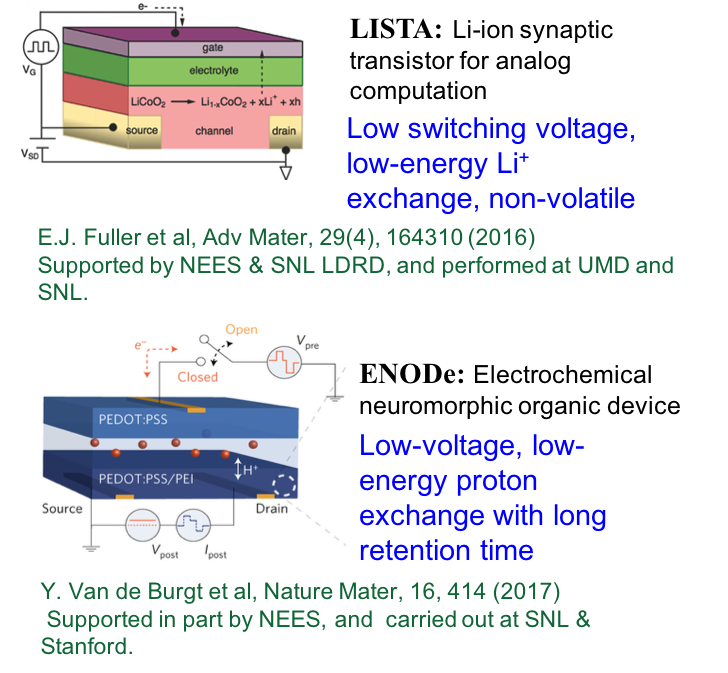
- LISTA and ENODe are inorganic & organic versions of a low-voltage, energy-efficient solid-state 3-terminal redox transistor (NVRT), where battery functionality controls ion intercalation and thereby NVRT characteristics as an analog memory device.
- NVRT scaling builds on NEES expertise in thin film solid state storage and solid electrolytes.
References
- Elliot J. Fuller, Farid El Gabaly, François Leonard, Sapan Agarwal, Steven J. Plimpton, Robin B. Jacobs-Gedrim, Conrad D. James, Matthew J. Marinella, A. Alec Talin, “Li-ion Synaptic Transistor for Low Power Analog Computing”, Advanced Materials, 29(4), pp 1604310, 2016. doi: 10.1002/adma.201604310.
- Yoeri van de Burgt, Ewout Lubberman, Elliot J. Fuller, Scott T. Keene, Gregorio C. Faria, Sapan Agarwal, Matthew J. Marinella, A. Alec Talin, Alberto Salleo, “A Non-volatile Organic Electrochemical Device as a Low-voltage Artificial Synapse for Neuromorphic Computer”. Nature Materials, 16, pp 414-418, 2017. doi:10.1038/nmat4856.
- A. Alec Talin, Dmitry Ruzmetov, Andrei Kolmakov, Kim McKelvey, Nicholas Ware, Farid El Gabaly, Bruce Dunn, Henry S. White, “Fabrication, Testing, and Simulation of all-Solid-State Three-Dimensional Li-Ion Batteries”, ACS AMI, 8, pp 82385, 2016, doi 10.1021/acsami.6b12244.
- Alexander J. Pearse, Thomas E. Schmitt, Elliot J. Fuller, Farid El-Gabaly, Chuan-Fu Lin, Konstantinos Gerasopoulos, Alexander C. Kozen, A. Alec Talin, Gary Rubloff, Keith E. Gregorczyk, “Nanoscale solid State Batteries Enabled by Thermal Atomic Layer Deposition of a Lithium Polyphosphazene Solid State Electrolyte”, Chemistry of Materials, 29(8), pp 3740-3753, 2017. doi: 10.1021/acs.chemmater.7b00805.
Summary
When batteries are cycled to insert or remove ions from an electrode, they change the properties of the electrode material. It would seem that this phenomenon could be exploited far beyond what happens today. Talin, NEES’ thrust leader for solid state energy storage, has demonstrated here a particularly exciting application – using a thin film battery to insert/deinsert ions into an electrode material, changing its electronic properties as a component of an analog transistor.
Normally, transistors involve a semiconducting channel of material (typically single-crystal Si) connecting two contacts (source, drain), with a high quality thin insulator separating the channel from a third contact (gate). The relative voltage on the gate electrostatically determines the electronic conductance of the channel. While such transistors operate extremely well for conventional circuits and computing, they cannot function as memory devices unless partnered with other devices (e.g., electrostatic capacitor). The work here replaces the channel and gate with battery electrode materials and substitutes a solid electrolyte for the electronic insulator. This allows battery function to insert/deinsert ions into the channel, changing its electronic conductance in a nonvolatile way (i.e., memory). Devices based on inorganic materials (LISTA) using Li ions and organic materials (ENODe) using protons have been separately published.
An immediate and exciting application is to analog memory devices, upon which neuromorphic computers are envisioned to support far more efficient machine learning applications. Talin’s demonstrations are pioneering as a new paradigm for neuromorphic computing, with numerous advantages – low energy switching, operation at very low voltages (~100mV), long retention times, and scalability to small lateral and vertical dimensions that are compatible with thin film processing. A number of NEES PI’s are very experienced in the electronics arena where thin film processing has always been at the frontier.
Acknowledgements
This work was supported in part by NEES, and carried out at SNL & Stanford
Quantifying irreversible structural & chemical evolution in dynamic lithiation/delithiation processes
Scientific Achievement
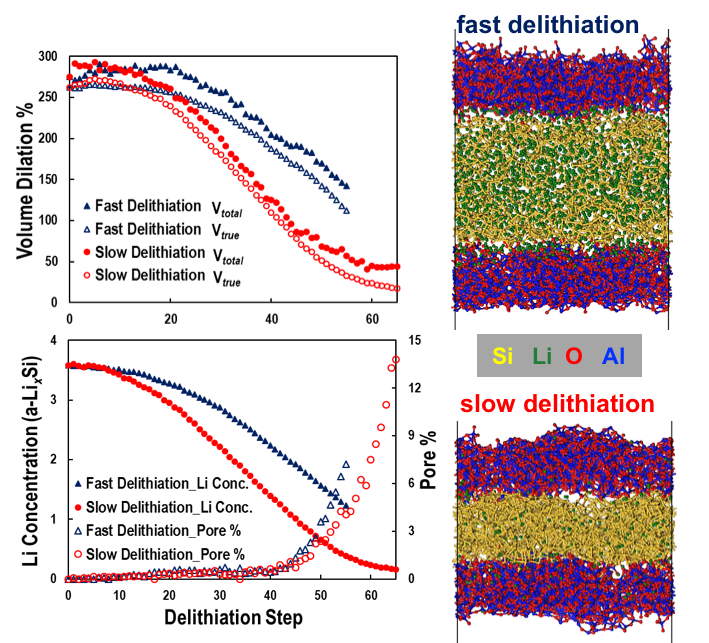
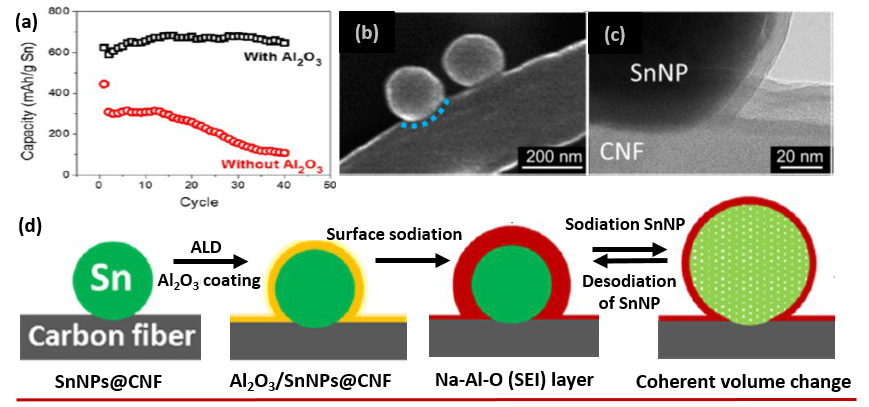
We developed a ReaxFF molecular dynamics simulation to track delithiation of an Al2O3-coated Si model system, revealing substantial dynamic changes in dimensions and composition. Fast delithiation produces produces capacity loss from expanded Si with trapped Li.
Significance and Impact
Atomistic MD simulation reveals dynamics critical for understanding and mitigating degradation, while providing quantitative guidelines for both design and operation.
Research Details
- Fast delithiation leads to trapped Li and the formation of interior nanopores, causing capacity loss and an expanded (141%) Si volume dilation. Slow delithiation leaves ~no trapped Li and a small (17%) volume dilation (from loss of Si-Si bonds), which in turn leads to faster 2nd cycle lithiation.
- Capacity degradation can be mitigated by (1) slower delithiation to suppress Li trapping in the Si and (2) limiting cutoff voltage to prevent delamination of the protection layer.
References
NEES modeling & experimental references- K. J. Kim et al., ”Atomistic Simulation Derived Insight on the Irreversible Structural Changes of Si Electrode during Fast and Slow Delithiation”, Nano Lett. 2017, 17(7), pp 4330-4338. Doi 10.1021/acs.nanolett.7b01389.
- S. Kim et al., ”Self-generated Concentration and Modulus Gradient Coating Design to Protect Si Nano-wire Electrodes during Lithiation”, PCCP, 2016, 18, pp 3706-3715. Doi 10.1039/C5CP07219K.
- K. J. Kim et al., ”Vacancies in Si can Improve the Concentration-dependent Lithiation Rate: Molecular Dynamics Sutdies of Lithiation Dynamics of Si Electrodes”, JPC-C, 2015, 119(43), pp 24265-24275. Doi 10.1021/acs.jpcc.5b0695.
- A.C. Kozen et al., “Next-generation Li Metal Anode Engineering via ALD”, ACS Nano, 2015, 9(6), pp 5884-5892. Doi 10.1021/acsnano.5b02166.
- C.F. Sun et al., “A Beaded-string Silicon Anode”, ACS Nano, 2013, 7(3), pp 2717-2724.Doi 10.1021/nn4001512.
- K. Karki et al., “Hoop-strong Nanotubes for Battery Electrodes”, ACS Nano, 2013, 7(9), pp 8295-8302. Doi 10.1021/nn403895h.
- S.C. DeCaluwe et al., “Pore Collapse and Regrowth in Silicon Electrodes for Rechargeable Batteries”, PCCP, 2015, 17, pp11301-11312. Doi 10.1039/C4CP06017B.
- X. Han, Y. Gong, K. Fu, X. He, G.T. Hitz, J. Dai, A. Pearse, B. Liu, H Wang, G.W. Rubloff, Y. Mo, V. Thangadurai, E.D. Wachsman, L. Hu, “Negating Interfacial Impedance in Garnet-based Solid-state Li Metal Batteries”, Nat Mater, 2017, 16, pp 572-579. Doi 10.1038/nmat4821.
- C-F. Lin, A.C. Kozen, M. Noked, C. Liu, G.W. Rubloff, “ALD Protection of Li-metal Anode Surfaces – Quantifying and Preventing Chemical and Electrochemical Corrosion in Organic Solvent”, Adv Mater Interfaces, 2016, 3(21), pp 1600426. Doi 10.1002/admi.201600426.
- W. Luo, C-F. Lin, O. Zhao, M. Noked, Y. Zhang, G.W. Rubloff, L. Hu, “Ultrathin Surface Coating Enables the Stable Sodium Metal Anode”, Adv Energy Mater, 2016, 7(2), pp 1601526-6. Doi 10.1002/aenm.201601526.
Summary
NEES has recognized the importance of multiple modeling and simulation approaches across its frontiers – DFT, molecular dynamics, continuum, etc. Here Yue Qi’s group features MD simulations aimed at understanding the nanoscale consequences of Si lithiation/delithiation (here the latter) and in the presence of a thin alumina based protective layer. While we normally think of the strong volume explansion, stresses, and cracking/pulverization associated with it as the results of lithiation/delithiation of Si, the results here provide much more insight:
- They show that Li can be trapped in the Si upon delithiation, contributing to capacity loss and leaving an expanded Si volume
- The tendency for Li trapping is stronger at higher delithiation rates, a kinetics consequence
- Even at slow delithiation rates where no trapped Li remains, the Si volume is left somewhat expanded by the presence of broken Si-Si bonds
- Appropriate voltage cycling limits can mitigate against delamination of the protection layer
In summary these results provide a methodology and results as guidelines for design of such structures and for operational parameters consistent with stability and performance of the structures.
Acknowledgements
This work was supported by NEES & BMR, and carried out at MSU.
Signature of stress-assisted Li+ diffusion for solid-state batteries
Scientific Achievement
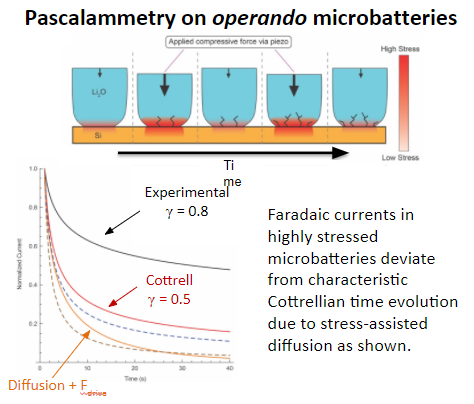
We developed a new scan probe technique pascalammetry, where stress is applied using operando solid-state microbattery probes (LiO2/Li) on Si cathode surfaces.
Significance and Impact
Li+ diffusional kinetics are directly impacted by mechanical stress, with detectable characteristics that signal high stress battery conditions. This provides a unique opportunity to gain critical insights of stress-induced degradation and failure in solid-state battery systems.
Research Details
- The analytic solution to a diffusion/activation equation is used to describe pascalammetry data.
- The observance of faradaic current due to stress-assisted diffusion in solid state systems is detectable by the power-law of charge evolution according to (t+1)^y-1, where 0.5 < y < 1.
References
NEES modeling & experimental references- Larson et al. Pascalammetry with Operando Microbattery Probes: Sensing High Stress in Solid-State Batteries (2017) submitted.
Summary
A condition common in battery systems is high mechanical stress that can be caused by electrode swelling, gaseous side reactions, and ion flux itself. A better understanding of ion transport dynamics in stressed battery materials is needed in order to develop effective detection and mitigation strategies for enhanced safety and performance. Here, NEES scientists from the University of Maryland at College Park present a newly developed electrochemical/mechanical technique of pascalammetry to investigate the behavior of stress induced faradaic current. Pascalammetry is enabled by a novel micro- & nano-scale scan-probe based experimental platform.
Similar to how voltammetry works, in pascalammetry, a stress waveform is applied to an electrochemical system – at constant chemical potential difference (bias voltage) – and induced currents are measured and analyzed. The measurements of operando solid-state microbattery probes (Li2O/Li) on the Si cathode surfaces reveal non-Cottrellian active-lithium diffusional kinetics due to stress-assisted Li+ diffusion. Further analysis shows that this non-Cottrellian behavior can be easily detected, providing unprecedented opportunity to directly measure stress in solid-state battery electrolytes, and to provide critical, quantitative information regarding the stress-related degradation and failure modes in solid-state energy storage systems.
Acknowledgements
This work was supported by EFRC NEES and performed at UMD.
A new synthesis process for Li+ conductive thin film ionogels
Scientific Achievement
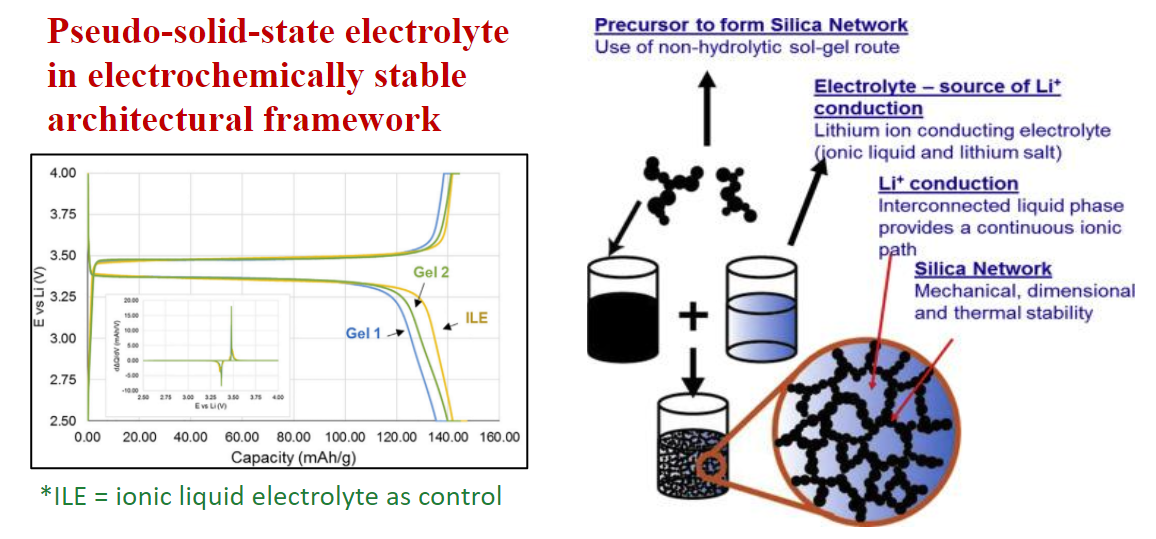
Using solution processing, we developed a synthesis method for ionogel electrolytes - ionic liquid trapped inside a mesoporous solid. This sol-gel matrix exhibits fluidic state on the nanoscale while behaves like a solid macroscopically.
Significance and Impact
The development of photo-patternable ionogel electrolyte provides promising fabrication methods for complex electrochemical architectures that can offer new opportunities to improve energy and power density for solid-state Li+ batteries.
Research Details
- Spin-coated, 600-nm-thick films of Li+ conducting ionogels were incorporated in electrochemical cells of LiFePO4|ionogel|Li. Cycled at C/2, the cells yielded capacities of 125 mAh/g with minimum capacity loss over 150 cycles.
- The UV crosslinking synthesis method enabled photo-patterning capability of ionogel electrolyte structures with 250-μm resolution.
References
- D.S. Ashby, R.H. DeBlock, C. Lai, C.S. Choi, B.S. Dunn, Patternable, Solution-Processed Ionogels for Thin-Film Lithium-Ion Electrolytes, Joule, 2017, 1(2), pp 344-358.
Summary
Ionogels have recently attracted attention as pseudo-solid-state electrolytes based on their ability to confine an ionic liquid electrolyte within the mesoporous network of a sol-gel derived inorganic matrix. This paper highlights two developments in ionogel research: A solution-processed sub-micrometer film and the formation of a photo-patternable inorganic electrolyte.
By using ionogel electrolytes, we form chemically and physically stable electrochemical structures with a low-impedance, liquid-solid interface. Solution processing helps ensure that the electrolyte penetrates throughout the electrode, increasing utilization. By forming thin-film ionogels, we decrease the ohmic loss attributed to the electrolyte increasing the achievable power density. The improved energy and power densities combined with solution processing underscore the versatility of ionogels for use in thin-film solid-state batteries. As demonstrated here, we incorporated spin-coated, 600-nm Li+-conducting ionogel films in electrochemical cells of LiFePO4/ionogel/Li. A key feature in this work is the ability to have the sol thoroughly penetrate the LiFePO4 electrode prior to gelation. Devices operating at C/2 achieved capacities of 125 mAh/g for some 150 cycles with minimal capacity loss.
The development of a synthesis route based on UV crosslinking enabled us to develop a photopatternable ionogel electrolyte. This approach provides promising fabrication methods for complex electrochemical architectures, which in turn offer new opportunities for electrochemical devices. Here, we demonstrated photo-patterning of the ionogel. The realization of a photo-patterned pseudo-solid-state electrolyte increases the versatility of ionogels and potentially enables new fabrication routes for electrochemical device architectures.
Acknowledgements
This work was supported by EFRC NEES and performed at UCLA.
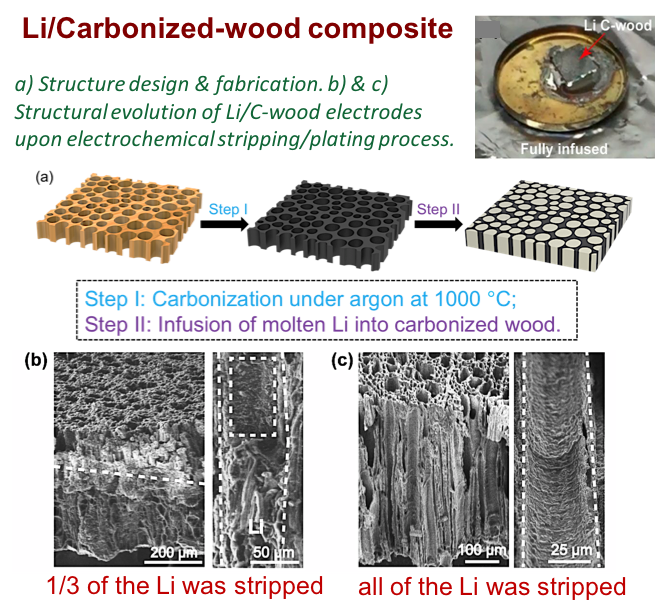
Nature-designed carbonized-wood scaffold for reversible Li+ cycling
Scientific Achievement
Wood-based anisotropic mesostructures provide a robust, highly porous & conductive 3D framework that both guides the Li stripping/plating process & contains volume changes, demonstrating long-term cycling stability under high current density (~150 h at 3 mA-cm-2) in symmetric Li ion battery cells.
Significance and Impact
Enlisting nature's design & fabrication as a new scalable synthesis paradigm, carbonized-wood mesoscale architectures achieve robust cycling of Li metal anode.
Research Details
- Well-aligned 3D wood channels with lithiophilic coating (ZnO) enables a homogeneous contact with fast Li+ flux for uniform Li nucleation & growth.
- Compared to bare Li metal, Li/C-wood electrode presents a lower over-potential (90 mV at 3mA.cm-2), more stable stripping/plating profiles, and better cycling performance.
- Similar improved stability has been demonstrated for the Na/C-wood composite system.
References
- Y. Zhang, W. Luo, C. Wang, Y. Li, C. Chen, J. Song, J. Dai, E. Hitz, S. Xu, C. Yang, Y. Wang and L. Hu, "High-capacity, low-tortuosity, and channel-guided lithium metal anode", PNAS (2017) 114 (14), 3584-3589. doi: 10.1073/pnas.1618871114.
Summary
Li metal anode with its high specific capacity (3,860 mAh.g-1) and low anode potential is extremely attractive to battery technologies, but challenges remain due to large Li volume change which would lead to the formation of SEI cracks and Li dendrites. Here we introduce a design of Li metal/carbonized wood (Li/C-wood) composite with structural properties ideally suited to address the above issues.
NEES scientists Liangbing Hu and coworkers designed and fabricated a highly porous C-wood 3D framework with well-aligned channels for Li metal anode. The C-wood electrode was fabricated by infusing metallic Li into the channel structures made possible by the ZnO coating, which ensures proper wettability and homogeneous contact with Li+ flux. The C-wood channels function as excellent guides for the stripping/plating process and effectively accommodate the resulting Li volume change. Moreover, the local current density has been significantly decreased due to the 3D channel structure to obtain uniform Li nucleation and growth while alleviating dendritic Li growth. As demonstrated in symmetric cells, the Li/C-wood electrode presents a lower overpotential (90 mV at 3mA.cm-2), more stable stripping/plating profiles, and improved cycling performance (∼150 h at 3 mA·cm−2) compared to the bare Li metal electrode.
The rational structure design of multifunctional mesoscale architectures, in this case utilizing nature-made materials that are both scalable and bio-degradable, provide a useful solution for fabricating high-capacity, dendrite-free Li metal anode.
Acknowledgements
This work was supported by DOE-EERE-BMR, CRA-MSME and EFRC-NEES for model development performed at U. of Michigan State.
Surface coating design to stabilize nanostructured Si electrode during lithiation
Scientific Achievement
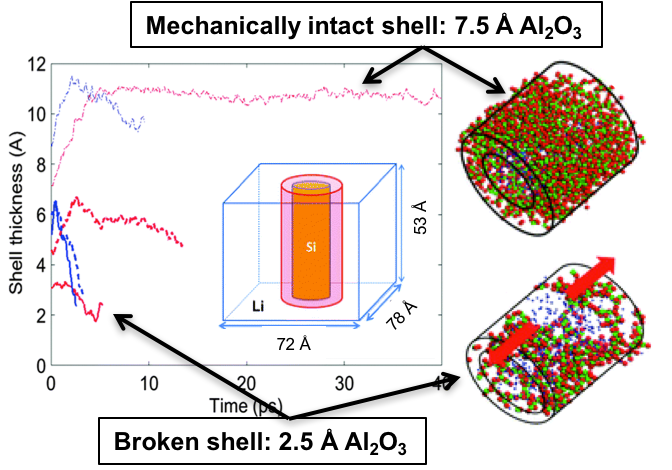
Reactive molecular dynamic simulations reveal that a Li concentration gradient in the Al2O3 shell, accompanied by an elastic modulus gradient, produces a mechanically stable core-shell nanostructure.
Significance and Impact
Newly developed Reactive Force Field (ReaxFF) molecular dynamics enables simultaneous tracking of chemical, structural and mechanical evolution of Si core-shell nanostructured electrode during lithiation, providing design guidelines to mitigate structural mechanical stress due to cycling.
Research Details
- ReaxFF parameters for Li-Si-Al-O system were developed by fitting quantum mechanics dataset.
- Reactive molecular dynamics (MD) simulations compare amorphous SiO2 and ALD-Al2O3 coatings(shell) on Si nanowires during lithiation.
- The modulus gradient in the coating, with softer outer and harder inner regions, helps to achieve a mechanically stable coating.
References
- S. Kim, A. Ostadhossein, A. van Duin, X. Xiao, H. Gao, Y. Qi, “Self-generated concentration and modulus gradient coating design to protect Si nano-wire electrodes during lithiation”, PCCP, 18, P.3706, 2016.
- K. Karki, Y. Zhu, Y. Liu, C. Sun, L. Hu, Y. Wang, C. Wang, J. Cumings, “Hoop-strong nanotubes for battery electrodes”, ACS Nano, 7(9), P.8295, 2013.
- C. Sun, K. Karki, J. Zheng, H. Liao, Y. Zhang, T. Li, Y. Qi, J. Cumings, G. Rubloff, Y. Wang, “A beaded-string silicon anode”, ACS Nano, 7(3), P. 2717, 2013.
Summary
Surface coatings such as atomic layer deposited (ALD) Al2O3 layers are thought of as an effective way to improve cycling performance of nanostructured Si electrodes. However, the chemical composition change and the diffusion-induced-stress profile of the coating materials during the lithiation/delithiation process are far from being understood.
In this work, NEES scientist Yue Qi, in collaboration with other colleagues, developed the reactive force field (ReaxFF) parameters for the Li-Si-Al-O core-shell nanostructure system. Reactive molecular dynamics simulations using the ReaxFF enables simultaneous tracking of the chemical, structural and mechanical evolution of the core-shell nanostructure during lithiation. Yue Qi et al. compared the lithiation kinetics of both Si-Al2O3 and Si-SiO2 core-shell nanostructures to seek insights of the stabilizing factors in Al2O3 coating.
They identified a well-defined Li density gradient along the lithiated Al2O3 shell that leads to an elastic modulus gradient, forming a harder inner and a softer outer lithiated Al2O3 shell makeup, yielding 3 positive effects – the innermost stiff region of the less-lithiated Al2O3 helps to confine the Si electrode volume expansion; a gradual Li insertion reduces the stress associated with swelling; the Al2O3 shell itself exhibits elastic property to avoid stress concentration and crack propagation.
This new mechanics model identified a critical size ratio needed to form a mechanically stable core-shell nanostructure during lithiation & delithiation process, providing insight into the design guidelines for electrode protection layers.
Acknowledgements
This work was supported by DOE-EERE-BMR, CRA-MSME and EFRC-NEES for model development performed at U. of Michigan State.
Modeling non-uniform Li transport in solid-state 3D Li-ion batteries
Scientific Achievement
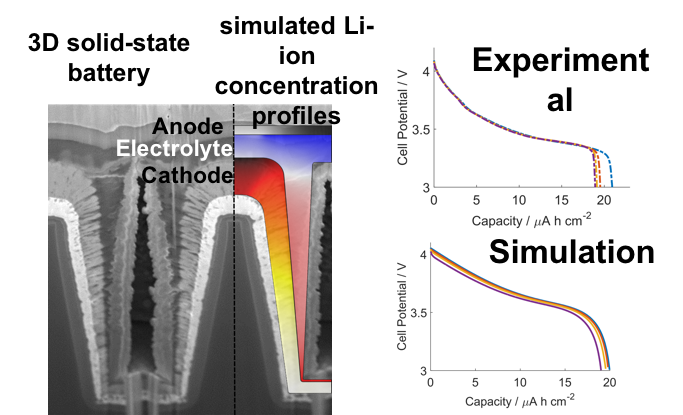
Finite-element multiphysics simulations guided by experiments reveal both spatial & temporal non-uniform cathode utilization due to 3D nano-geometry and low LiPON conductivity, leading to capacity loss at higher power & local degradation sites.
Significance and Impact
Combining simulations & experiments provides guidance for nanostructure design principles, emphasizing the role of 3D geometry in determining power performance and geometry-dependent degradation hotspots.
Research Details
- Small structural and compositional inhomogeneities lead to large spatial inhomogeneities in capacity utilization and degradation.
- This 3D finite element model includes troictropic and potential dependent diffusivity in the LiCoO2 cathode, capacity-dependent potential of the Si anode, in addition to the Butler-Volmer kinetics and diffusional/migrational mass transport.
References
A.A. Talin, D. Ruzmetov, A. Kolmakov, K. McKelvey, N. Ware, F. El Gabaly, B. Dunn, H.S. White, “Fabrication, Testing & Simulation of All Solid State 3D Li-ion Batteries”, submitted, 2016.
Summary
NEES scientists demonstrated fully-functional 3D Solid State Lithium Ion Batteries (SSLIB) with microscale internal dimensions fabricated using materials and thin film deposition methods. Analysis of the experimental results using finite element modeling indicates that the origin of the observed poor power performance is the structural inhomogeneity of the 3D SSLIB, coupled with low electrolyte ionic conductivity of LiPON, which lead to highly non-uniform internal current density distribution and poor cathode utilization with localized Li+ depletion at cathode interface. Simulation result with conformal electrolyte geometry demonstrated reduced potential losses, but did not affect the cathode diffusion effects, suggesting that future 3D SSLIB designs will necessarily have to account for limited Li-ion transport behavior.
Talin and coworkers at Sandia NL successfully demonstrated a working 3D SSLIB prototype consisting of conical Si microcolumns onto which layers corresponding to the current collector, LiCoO2 cathode, LiPON electrolyte and Si anode, are sequentially deposited using physical vapor deposition (PVD). However, the power performance of these 3D structures lags significantly (a capacity decrease of almost 90% with increasing C-rate) compared to the similarly prepared 2D planar batteries. The finite element COMSOL model was based on the conical shape elements of the 3D SSLIB experimental cross section image. The model simulation incorporates both diffusion and migration of Li+ within the LiPON electrolyte, while the transport of Li+ within the LiCoO2 cathode and Si anode was assumed to occur only by diffusion. For the anode/electrolyte and cathode/electrolyte interfaces, we used potential-dependent Butler-Volmer (BV) kinetic expressions to account for local Li+ concentration as well as the local activation overpotential.
Acknowledgements
This work was supported by EFRC NEES, NIST.
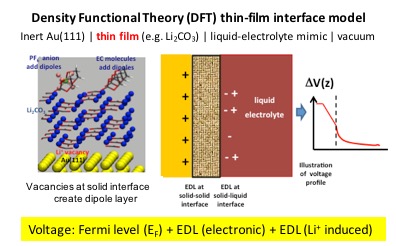
What is "voltage" at atomic lengthscale in battery electrodes?
Scientific Achievement
Electric double layers EDL (dipole layers) are predicted to exist at both solid-solid & solid-liquid interfaces, where the solid interfaces can absorb voltage drops to widen electrolyte stability window.
Significance and Impact
Consideration of both e- & Li+ movement is essential in manipulating surface dipoles as a viable strategy to improve electrode passivation.
Research Details
- This model distinguishes the computed instantaneous voltage governing electron movement from the slower-responding voltage governing Li content at interfaces, in order to achieve a comprehensive description of electrochemical activities on electrode surfaces.
- Modeling included relatively inert thin films Li3PO4 & Li2CO3, & cathode oxide LMO. Result showed that the applied voltage is strongly correlated with the surface dipole density at the surface.
- Anion-induced spatial inhomogeneity can yield parasite reaction hotspots as shown in the LMO system.
References
Kevin Leung & Andrew Leenheer, “How voltage drops are manifested by lithium ion configurations at interfaces & in thin films on battery electrodes”, J. Phys Chem C, 119, 10234-10246 (2015) DOI: 10.1021/acs/jpcc.5b01643.
Summary
Battery electrode surfaces are generally coated with electronically insulating solid films of thickness on the order of 1-50 nm. In lithium ion battery, both electrons and Li+ ions can moved in the surface films and in the electrodes themselves in response to applied voltage changes. Consequently, the structures of electric dipole layers (EDL) and the atomic length scale effect of voltages became much more complex than the pristine noble metal electrodes (e.g. Pt) used in classical electric double layer studies. Incorporating and distinguishing the electronic and the ionic voltage components are critical for a comprehensive description of electrochemical activities on electrode surfaces, such as Li+ insertion dynamics, SEI formation, and electrodeposition at overpotentials.
In this work, NEES scientist Kevin Leung applied density functional theory (DFT) to investigate how the applied voltage is manifested as changes in the EDL at atomic length scales, including charge separation and interfacial dipole moments. He explicitly distinguished between the instantaneous electronic voltage and the slower ionic Li+ voltage, clarifying what is the "voltage" in atomic simulations and constructed electrode interface models that exhibit consistent electrochemical activities for both Li-insertion reactions and parasitic processes (e.g., SEI formation). The electric double layer components are predicted to exist at both solid-liquid and solid-solid interfaces.
Acknowledgements
Work was performed at Sandia NL - NM and supported by EFRC NEES.
From electron tunneling model to anode protection
Scientific Achievement
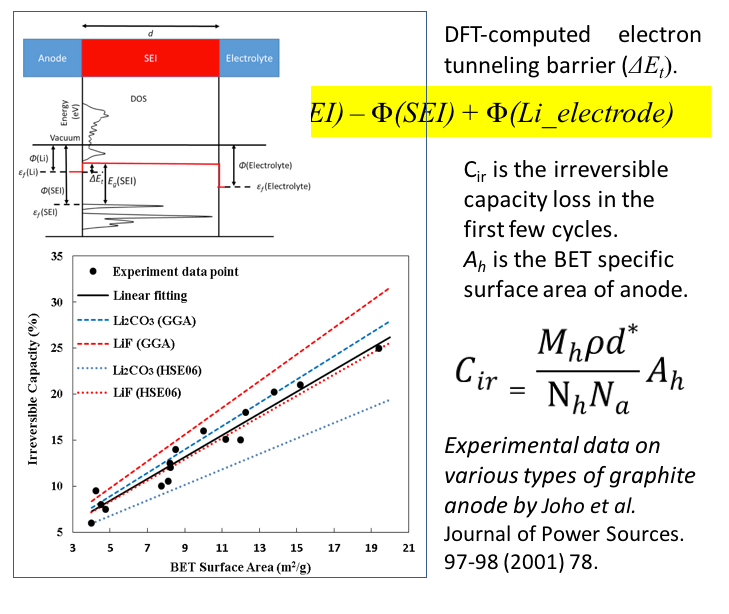
A density function theory (DFT) - based electron tunneling model was used to assess the electronic insulating ability of inorganic SEI components (Li2CO3, LiF, Li3PO4), yielding useful quantifiable parameters - electron tunneling barrier, critical thickness & initial irreversible capacity loss caused by Li+ ion consumption.
Significance and Impact
Predictive modeling allows meaningful design principles for anode protection to circumvent cycling instability and capacity loss.
Research Details
- The model-predicted irreversible capacity loss due to solid electrolyte interphase (SEI) agrees well with experiments. The initial irreversible capacity loss is due to Self-limiting Electron Tunneling Property of SEI.
- Electron tunneling barrier decreases under tension and increases under compression, causing non-negligible effect on the critical thickness & irreversible capacity loss due to deformation.
References
Y. Lin, Z. Liu, K. Leung, L. Chen, P. Lu, Y. Qi, J. Power Sources 309, 221-230 (2016) DOI: 10.1016/j.jpowsour.2016.01.078.
K. Leung, Y. Qi, K. Zavadil, Y. Jung, A. Dillon, A. Cavanagh, S. Lee, S. George, J. Am. Chem. Soc. 133, 14741 (2011)
Summary
It is generally recognized that the formation and continuous growth of a solid electrolyte interphase (SEI) layers are responsible for the irreversible capacity loss of batteries in both the initial and subsequent stages of cycling. In a previous work, NEES Scientists Leung et al. used ab initio molecular dynamics (AIMD) and constrained density function theory (cDFT) methods to model the electrolyte decomposition dynamics of nm-thick artificial oxide SEI layer. It was shown that the thin SEI layers slow down the electron transfer rate because of its electron tunneling barrier.
Here, based on the tunneling barrier obtained from DFT calculations, they developed a simple analytical model to estimate the first cycle irreversible capacity loss due to the Li ions consumed in the formation of these SEI layers on the anode surface, and compared its predictions with experimental measurements with good agreement. It was shown that the initial irreversible capacity loss is due to the self-limiting electron tunneling property of the SEI. The critical thickness d* needed to block electron tunneling on the electrode surface for inorganic SEI components (LI2O3, LIF and Li3PO4) were calculated to be between 2 and 3 nm. Other electron transport mechanisms are still needed in order to explain the electron leakage through thicker SEI components (10-100 nm).
Qi and Leung also looked at the coupling effect of stress, e.g. tension and compression, induced by electrode volume expansion. To demonstrate, the model indicated that a 10% volume expansion of graphite would cause a 4.5% increase in critical thickness of SEI and 11% increase in the irreversible capacity loss considering the deformed structure of LiF.
Acknowledgements
Simulation work was performed at MSU, supported by EFRC NEES & NSF GOALI.
Water-activated Mg2+ insertion into MnO2 nanostructure electrode
Scientific Achievement
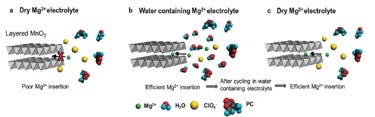
Enhanced Mg2+ insertion/deinsertion was observed in the presence of water molecules in conventional magnesium electrolyte. Consecutive cycling in water containing electrolyte "activates" MnO2 electrode by which improved Mg2+ insertion has been demonstrated in the dry magnesium electrolyte.
Significance and Impact
Observed Mg2+ insertion capability and cycling stability of MnO2 nanowire suggest potential of MnO2 as a promising cathode material for Mg-ion battery.
Research Details
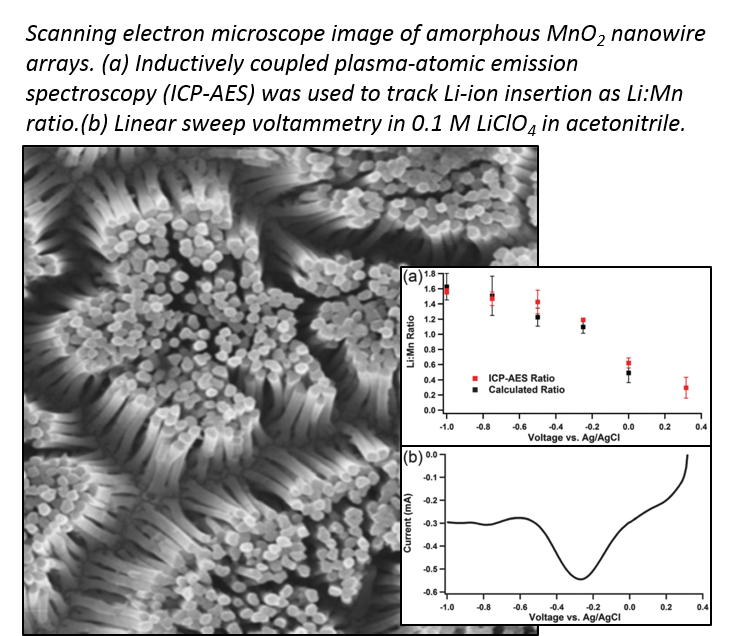
- Degree of Mg2+ insertion in the electrolytes with various water content was probed using ICP-AES.
- Presence of water molecules in the conventional electrolyte significantly enhances Mg2+ insertion/deinsertion.
- Portion of water molecules co-insert/deinsert along with Mg2+ ions into MnO2 as shown by EQCM.
- Enhanced Mg2+ insertion was observed without presence of water molecules after consecutive cycling in the water containing electrolyte.
References
J. Song, M. Noked, E. Gillette , J. Duay, G. Rubloff & SB Lee, “Activation of a MnO2 Cathode by water-stimulated Mg2+ insertion for magnesium ion battery”, PCCP, 17, 5256-5264 (2015) DOI: 10.1039/c4cp05591h.
Summary
For divalent electrochemical storage systems such as Mg-ion battery, compared to the monovalent Li-ion counterpart, major developmental challenges remain which prevented a full realization of technological advancement. In particular, the slow kinetics associated with Mg2+ ion mobility has been tested with different host cathode materials without any significant breakthroughs.
In the present study, we used two strategies to facilitate Mg2+ insertion/deinsertion: 1) nanostructured cathode materials to reduce the ionic diffusion path, and 2) introduction of a small amount of strong dipole molecules, such as H2O molecules, to shield the divalent charges in order to reduce electrostatic interactions.
NEES scientists revealed that the magnitude of Mg2+ insertion into MnO2 nanostructured cathode highly depended on the ratio between water molecules and Mg2+ ions present in the electrolyte. Optimal ratio was shown to be 6:1 for H2O:Mg2+ in the electrolyte for highest Mg ion insertion capacity in our system. Furthermore, we demonstrated that sufficient electrochemical reaction in water-containing electrolyte can prime the nanostructured cathode material for enhanced insertion/deinsertion, even in the absence of water molecules.
Utilizing the synergistic effect of both strategies, this work demonstrated the potential of MnO2 nanowire cathode as a host materials for the divalent Mg-ion system.
Acknowledgements
Work was performed at University of Maryland and supported by EFRC NEES.
Direct electrical signatures of degradation & failure
Scientific Achievement
This is the first direct in-situ signatures of the dc resistance of ultralong δ-MnO2 NW arrays as a function of the equilibrium electrical potential and Li+ content. Extremely high degree of dispersion for MnO2 nanosheets within the NW associated with high porosity as shown by TEM, is needed to achieve state-of-the-art charge storage performance.
Significance and Impact
This unique experimental setup provides a universal tool to study degradation in a massive array that mimic highly dense nanostructured electrodes in practice.
Research Details
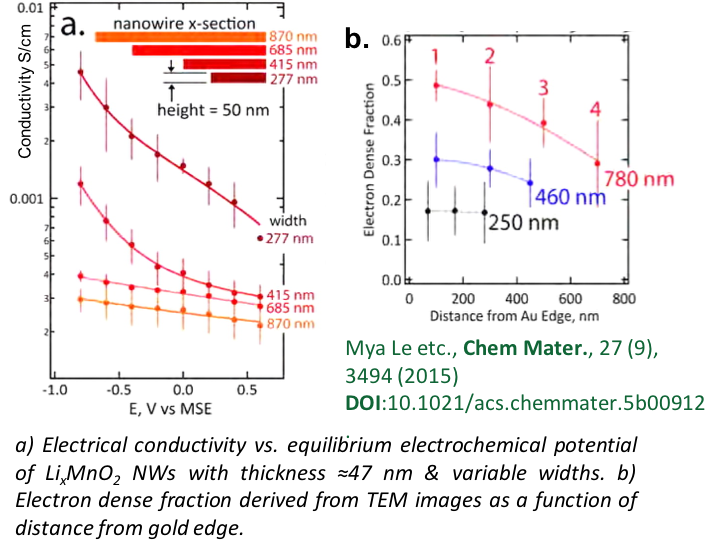
- As the equilibrium electrode potential is decreased from 0.60V to -0.80 V vs. MSE and Li+ is intercalated, the electrical conductivity of δ-MnO2 nanowires (NW) increases by up to one order of magnitude.
- TEM analysis of LixMnO2 NW density implicated the NW porosity for the observed conductivity.
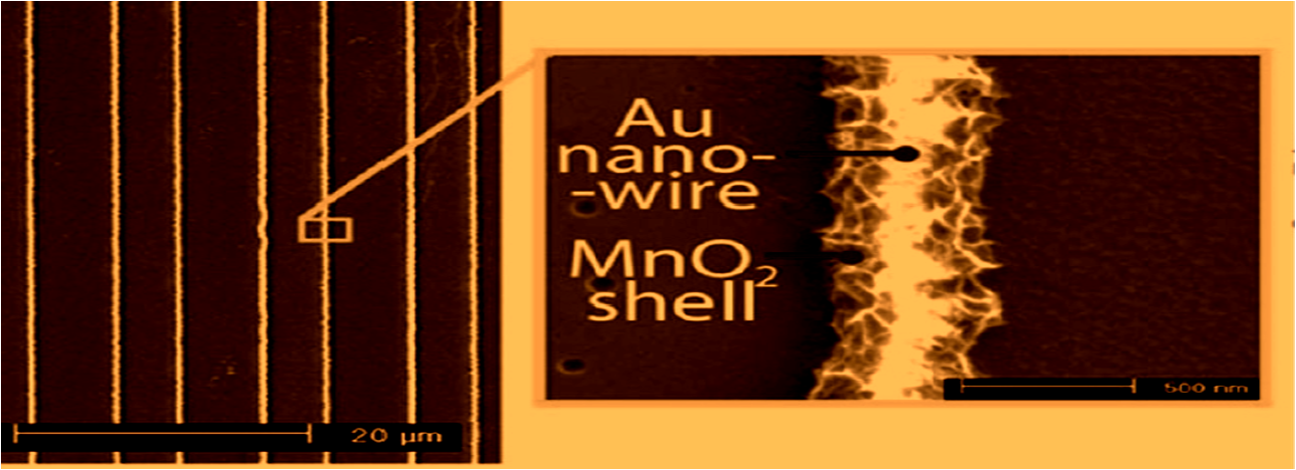
- Ultralong arrays of Au@δ-MnO2 core-shell NWs (mm’s) allow spatial location of local defect sites and subsequent experiments to validate degradation mechanisms.
References
My Le, Yu Liu, Hui Wang, Rajen K. Dutta, Wenbo Yan, John C. Hemminger, Ruqian Q. Wu, Reginald M. Penner, Chem Mater (2015) 27(9), 3494-3504. DOI a href="https://dx.doi.org/10.1021/acs.chemmater.5b00912">10.1021/acs.chemmater.5b00912.
Wenbo Yan, Mya Le Thai, Rajen Dutta, Xiaowei Li, Wendong Xing, Reginald M. Penner, ACS Appl Mater Interfaces (2014) 6(7), 5018. DOI 10.1021/am500051d.
Summary
In-situ electrical conductivity of LixMnO2 nanowires.
Earlier Penner et al. pioneered a lithographic synthesis technique (LPNE) for forming very long nanowires of controlled cross section, with impact on understanding the behavior of oxide nanostructures, and with promise for elucidating degradation and failure mechanisms. Fabrication of 200 MnO2 nanowires in parallel (40-60nm high x 275-870nm wide) spanning a 10 µm gap between two Au contacts has enabled determination of nanowire electrical conductivity as a function of lithiation, revealing pronounced disparities in electrical conductivity between LiMnO2 and MnO2. TEM showed distinct differences in porosity as a function of nanowire width, and charge storage capacity increased with porosity.
The detailed results illustrate for us the potential value of the LPNE approach for degradation studies - to understand dynamic changes in transport, structure, and storage capacity as a function of nanostructure design.
Acknowledgements
This work was supported as part of EFRC NEES; the XPS data was funded by DOE BES; DFE calculations by CaSTL, NSF.
100K cycles & beyond: extraordinary cycle stability using gel electrolyte
Scientific Achievement
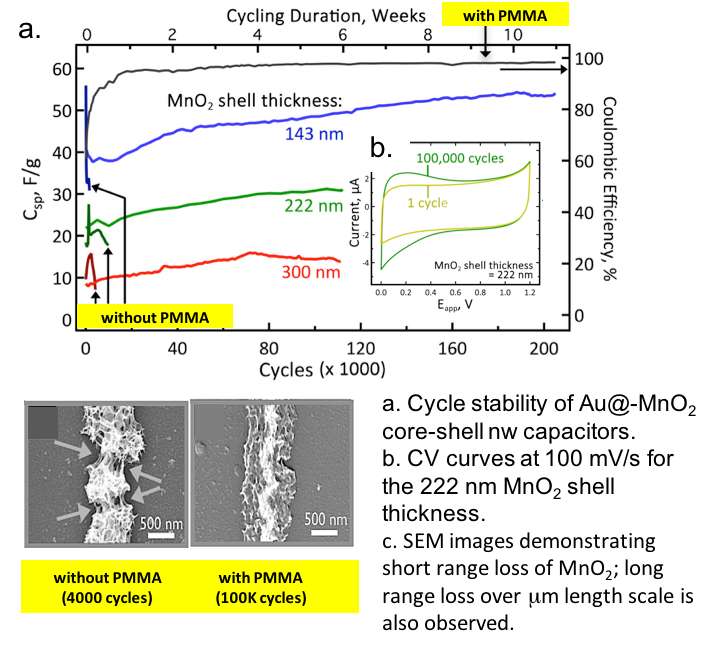
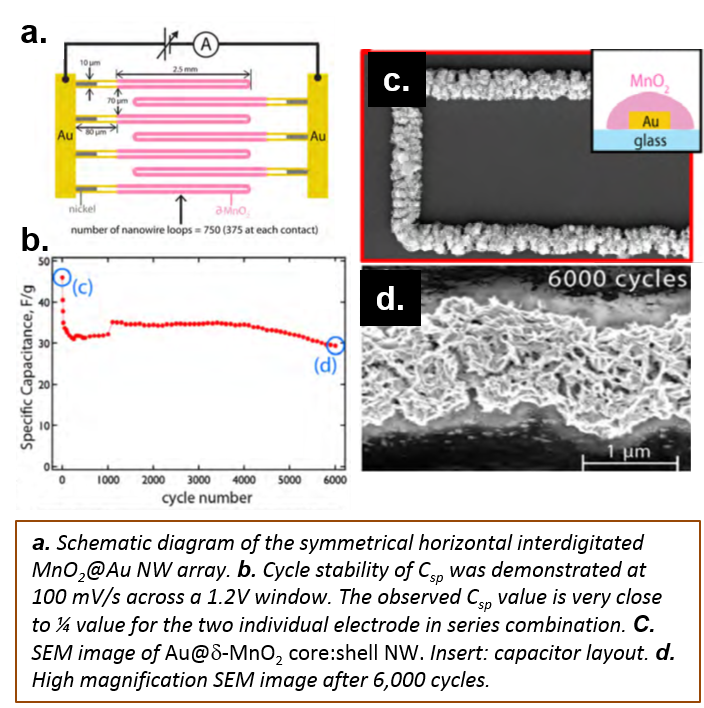
Incorporating PMMA gel stabilizes cycling of ultra-long Au@δ-MnO2 core-shell nanowire capacitors, allowing Li+ insertion/deinsertion up to 200K cycles at 95% Coulombic efficiency (> 10X longer cycling than without PMMA).
Significance and Impact
Nanostructures stabilization by gel is promising for liquid and solid state electrolyte systems. This and precision nanostructure design offer valuable testbed to understand degradation.
Research Details
- Parallel experiments were performed using two electrolytes – 1.0 M LiClO4 in propylene carbonate (PC) without & with added 20 (w/w)% PMMA.
- MnO2 oxide shell of the nanowire continue to access insertion-based capacity for more than 100K cycles, as shown by the scan rate dependence of Csp as a function of potential.
- SEM analysis showed nanoscaled MnO2 loss and subsequent microscale loss features.
References
Mya Le, Girija Thesma Chandran, Rajen K. Dutta, Xiaowei Li, and Reginald Penner, “100k Cycles and Beyond: Extraordinary Cycle Stability for MnO2 Nanowires Imparted by a Gel Electrolyte”, ACS Energy Lett., (2016), 1, 57-63. DOI: 10.1021/acsenergylett.6b00029.
Summary
Researchers funded by Nanostructures for Electrical Energy Storage (NEES), a DOE Energy Frontier Research Center (EFRC), have demonstrated reversible cycle stability for up to 200,000 cycles with 94-96% Coulombic efficiency for symmetrical δ-MnO2 nanowire capacitors. By using a unique Degradation & Failure Discovery Platform consisting of two interpenetrating arrays of 375 ultralong (5 mm) core@shell Au@δ-MnO2 nanowires, a design feature intended to accentuate the influence of defects caused by degradation, Penner’s group at UCI accomplished extraordinary cycling performance by replacing the liquid electrolyte with a poly(methyl methacrylate) (PMMA) gel electrolyte. In the normal PC electrolyte without PMMA, the system showed dramatically reduced cycle stabilities.
These experiments demonstrate for the first time that nanowire-based battery and capacitor electrodes are capable of providing extremely long cycle lifetimes. In addition, evidence shows that MnO2 oxide shell of these nanowires continues to access insertion-based capacity. Based on the SEM analysis, one mechanism for the extended cycle life could be by mechanical confinement of the MnO2 shell materials on the gold nanowire current collector. Further investigation of the mechanical properties will be required.
Acknowledgements
This work was solely supported by EFRC NEES.
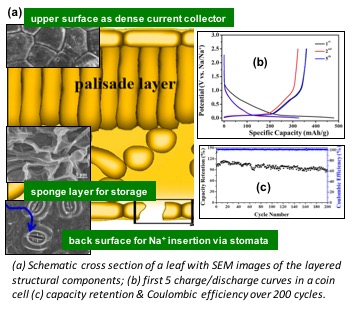
Carbonized leaf membrane as Na+ battery anode
Scientific Achievement
We used a single-step thermal pyrolysis procedure to transform a leaf into a carbon membrane to utilize the plant’s hierarchical porosity network for electrochemical storage. Here for the first time we created a (sodium ion) battery (SIB) with a natural leaf structure for the carbon anode, without binder, additive, or additional current collector.
Significance and Impact
Hierarchical capillary transport in the leaf presents a nature-designed ion transport network for electrochemical energy storage.
Research Details
- The carbonized leaf (1000°C under Ar) maintains a high charge capacity of 360 mAh/g and an initial Coulombic efficacy at 74.8% which remains stable over the next 200 cycles.
- For structural characterization, XRD pattern & Raman spectra were used along with SEM/TEM.
- Based on the resistance measurements, the electrical conductivity of the welded carbonized leaves was 710 s/m compared to 1250 s/m for the single leaf.
References
Hongbian Li, Fei Shen, Wei Luo, Jiaqi Dai, Xiaogan Han, Yanan Chen, Yonggang Yao, Hongli Zhu, Kun Fu, Emily Hitz, and Liangbing Hu “Carbonized-leaf membrane with anisotropic surfaces for sodium-ion battery” ACS Appl. Mater. Interfaces, 2016, 8(3), 2204-2210. DOI 10.1021/acsami.5b10875.
Summary
Nanostructures for Electrical Energy Storage (NEES) scientist Liangbing Hu and collogues at University of Maryland have cleverly taken advantage of the structural designs pre-selected by nature’s functional requirements in leaf, the most abundant biomass on Earth. As the anode for sodium ion batteries, carbon membranes derived from leaves have existing anisotropic surfaces with ideal porous mesostructures in between – the nonporous upper surface as a dense current collector, the sponge layer of carbon nanosheets for storage, and the back surface with stromata channels for sodium insertion. Hu et al. converted leaf’s meso- and macro-structures into utilizable hard-carbon precursor for SIB anodes through high temperature carbonization.
For the first time, they demonstrated a free-standing (binder-free, current-collector-free) anode for rechargeable SIBs, exhibiting a high specific capacity of 360 mAh/g and a high initial Coulombic efficiency of 75%. Moreover, as a proof of concept with scalable potentials, they showed the working of welded leaf carbon network. Future work remains to investigate possible welding mechanism(s) and/or the electron and ionic transport pathways.
Morphological characterization of the carbonized leaf was obtained using SEM/TEM, and electrochemical measurements were conducted using 2032 coin cells with Na plates as reference electrode.
Acknowledgements
Work was performed at UMD & supported by EFRC NEES.
Press Release
Balancing meso-structural stability & ionic transport
Scientific Achievement
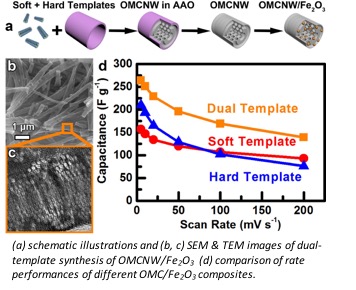
The soft-hard dual-template strategy provides a high pore volume and surface area OMCNW (ordered mesoporous carbon nanowires) with stable meso-structure upon Fe2O3 loading. The unique nanowire morphology and mesoporous structure of the OMCNW/Fe2O3 facilitate high ionic mobility in the composite, leading to >260 Fg-1 specific capacitance with good rate capability and cycling stability.
Significance and Impact
The discovering of a carbon framework with balanced meso-structure and morphology can serve to optimize both electronic and ionic transports in electrochemical energy storage and conversion.
Research Details
- AAO and copolymer F127 are used together as hard and soft templates to fabricate OMCNW.
- Compared to the soft-templated FDU-15, dual-templated composites showed X2 the total surface area and X6 the total pore volume, while maintaining mesostructural stability.
- The synergistic effects of dual-template strategy on meso-structure were investigated by HRTEM & N2 sorption. The meso-structure and morphology influence on electrochemical properties were studied by EIS and CV.
References
Junkai Hu, Malachi Noked, Eleanor Gillette, Fudong Han, Zhe Gui, Chunsheng Wang and Sang Bok Lee, “Dual-template synthesis of ordered mesoporous carbon/Fe2O3 nanowires: high porosity and structural stability for supercapacitors”, J. Mater. Chem. A, 2015, 3, 21501, DOI 10.1039/C5TA06372H.
Junkai Hu, Malachi Noked, Eleanor Gillette, Zhe Gui and Sang Bok Lee, “Capacitance behavior of ordered mesoporous carbon/Fe2O3 composites: Camparison between 1D cylindrical, 2D hexagonal, and 3D bicontinuous mesostructures”, Carbon, 2015, 93, 903, DOI 10.1016/j.carbon.2015.06.019.
Summary
As shown in a previous study, Nanostructures for Electrical Energy Storage (NEES) PI Sang Bok Lee compared soft- and hard-template synthesis strategies to gain insights into mesoporous morphology and structural stability of ordered mesoporous carbon as promising active metal oxide storage scaffolds. It was shown that mesostructure stability is a critical parameter that can limit the usefulness of the commonly used 2D CMK-3 structure, synthesized using hard-templated method. In this work, NEES PIs SB Lee and C Wang developed a dual-template synthesis strategy in order to take advantage of both methodologies: 1) the stable mesostructure from the soft-template method, and 2) the high pore volume and surface area from the hard-template method.
Authors incorporated Fe2O3 nanoparticles into a dual-templated OMCNWs structure to fabricate a composite with optimized structural characteristics and electrochemical performances not achievable using either of the single-templated methods alone. Compared to the soft-templated (FDU-15) and hard-templated (CMK-8) mesoporous structures, the new dual-templated OMCNW/Fe2O3 composites demonstrated large surface area and pore volume size, large specific capacitance (264 Fg-1) with easy ion accessibility (EIS analysis), high rate capacitance retention and stable cycling performance over 1000 cycles.
This work provided us with a comprehensive comparison of ordered mesoporous carbon structures from different synthesis strategies as host materials for Fe2O3, and as a guideline for future design principles of mesostructure framework.
Acknowledgements
Work was performed at UMD & supported by EFRC NEES.
Improving Lithium Battery Performance by Characterizing Native Processes
Scientific Achievement
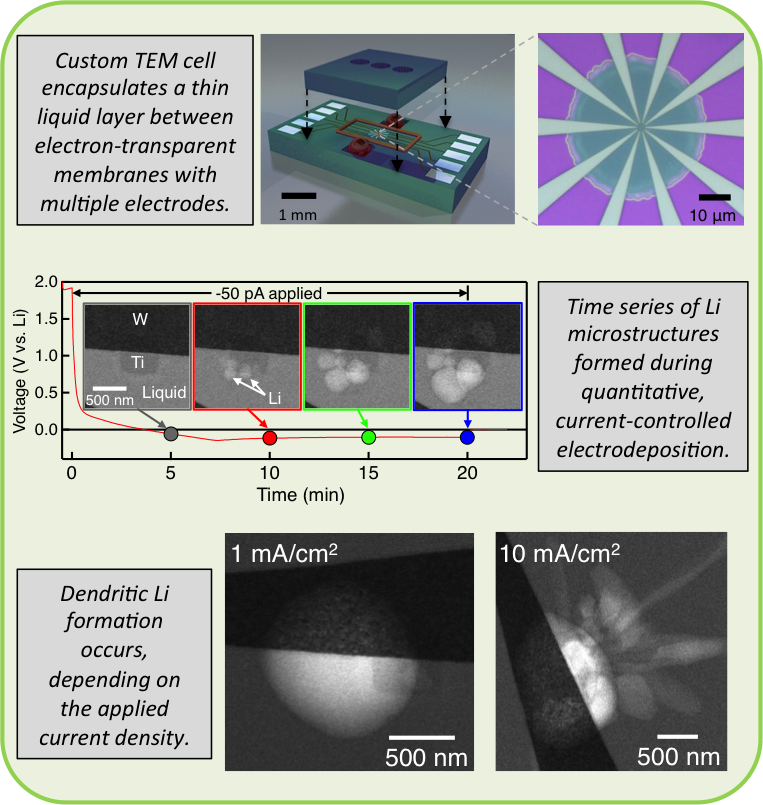
Actual lithium-ion-battery operating conditions now can be replicated inside a transmission electron microscope (TEM). Compared to other liquid cells, this new platform uniquely enables nanoscale observations of lithium cycling at controlled rates.
Significance and Impact
High-capacity lithium battery electrodes can be improved by preventing dendritic lithium deposits. By understanding how these deposits form, we can reduce safety concerns and dramatically increase electrode capacity, potentially by 10x.
Research Details
- TCycled battery-relevant electrolytes in our chemically compatible, multi-electrode device.
- Observed lithium deposit nucleation and growth.
- Manipulated the lithium deposit structures using electrochemical and electron beam control.
References
A. J. Leenheer, K. L. Jungjohann, K. R. Zavadil, J. P. Sullivan, C. T. Harris, ACS Nano (2015) 9(4), 4379. DOI: 10.1021/acsnano.5b00876.
A. J. Leenheer, J. P. Sullivan, M. J. Shaw, C. T. Harris, JMEMS (2015) 24(4), 1061. DOI: 10.1109/jmems.2014.2380771.
Summary
Electrodeposited metallic lithium is an ideal negative battery electrode, but non-uniform microstructure evolution during cycling leads to degradation and safety issues.
NEES scientists at Sandia National Laboratories designed a standalone, custom microfabricated, sealed liquid cell for in situ scanning transmission electron microscopy (STEM) to image the first few cycles of lithium electrodeposition and dissolution in liquid aprotic electrolyte at submicron resolution. Each cell contain 10 relatively small (0.26 μm2) working electrodes, allowing the ability to perform multiple experiments under identical chemical conditions. To simulate conditions in common Li-ion batteries with aprotic solvent-based electrolytes, the TEM liquid cell was filled with equal parts by volume ethylene carbonate and dimethyl carbonate containing 1 M lithium hexafluorophosphate salt (1:1 EC:DMC / 1 M LiPF6 ).
The electrodeposition and stripping of Li is shown to be spatially localized, rendering it susceptible to degradation and safety issues exemplified in dendrite formation. This localization is modulated by formation of solid elecrtrolyte interphase (SEI) layers and defects. Even at low dose, electron beam was found to affect the morphology of dendrite formation and growth dynamics, with implications for operando STEM liquid cell imaging and Li battery applications. Our results show that the SEI plays a critical role in Li dendrite initiation.
Acknowledgements
This work was supported in part by an LDRD project at Sandia National Laboratories and in part by Nanostructures for Electrical Energy Storage, an EFRC funded by DOE. This work was performed at CINT.
ALD Protection of Next-Generation Metal Anodes
Scientific Achievement
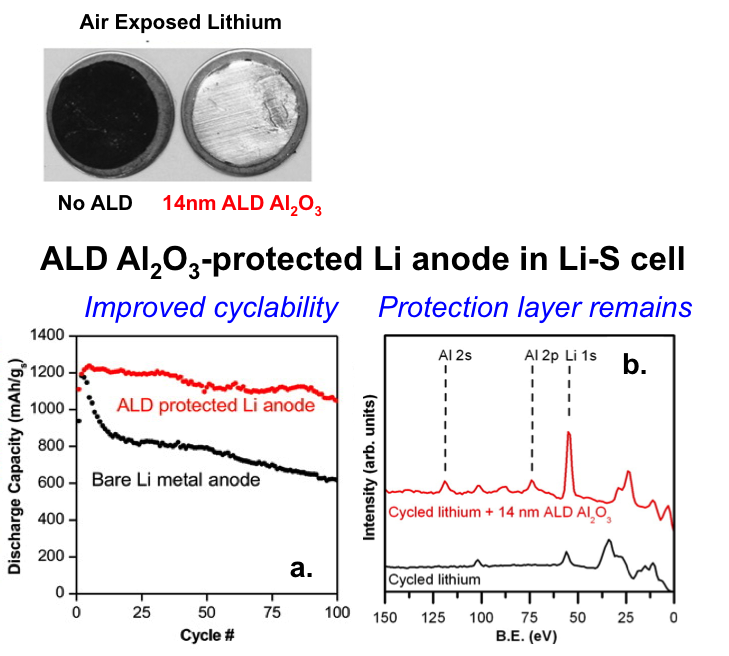
Using atomic layer deposition (ALD), we deposited thin (14nm) Al2O3 layers directly onto Li metal anodes, providing corrosion protection against atmosphere, organic solvent & other chemical species, and enhancing cyclability in Li-S cells.
Significance and Impact
Metal anodes are recognized as promising candidates for the next-generation beyond-Li-ion batteries using advanced oxide, sulfur, or oxygen cathodes, but their high reactivity requires corrosion protection while maintaining good ion transport and electronic insulation at the anode surface.
Research Details
- Integrated ALD, XPS, and battery testing without ambient exposure enable observation of post-cycling surface conditions.
- Li metal protected with 14 nm ALD Al2O3 drastically reduces first cycle capacity loss in the Li-S system by preventing anode corrosion in the presence of S species in the electrolyte.
References
Kozen, A.C.; Lin, C.F.; Pearse, A.J.; Schroeder, M.A.; Han, X.; Hu, L.; Lee, S.B.; Rubloff, G.W.; Noked, M. Next-generation Lithium Metal Anode Engineering via Atomic Layer Deposition. ACS Nano 2015, 9(6), 5884.
Kozen, A.C.; Pearse, A.J.; Lin, C.F.; Schroeder, M.A.; Noked, M.; Lee, S.B.; Rubloff, G.W. Atomic Layer Deposition and in Situ characterization of Ultraclean Lithium Oxide and Lithium Hydroxide. J. Phys. Chem. 2014, 118, 27749.
Leung, K.; Qi, Y.; Zavadil, K.R.; Jung, Y.Sl; Dillon, A.C.; Cavanagh, A.S.; Lee, S.; George, S.M. Using Atomic Layer Deposition to Hinder Solvent Decomposition in Lithium Ion Batteries: Frist-principles Modeling and Experimental Studies. J. Am. Chem. Soc 2011, 133, 14741.
Summary
Due to the high energy density of 1840 mAh/g for Li metal, the battery community is increasingly considering the lithium metal anode systems - including sulfur, oxygen/air, and advanced oxide cathode systems, as a promising next-generation battery technology beyond Li-ion. However, the extreme reactivity of the Li surface results in parasitic reactions with solvents, contamination, and shuttled active species in the electrolyte, posing serious limitations particularly in capacity retention with charge/discharge cycling.
Using a unique ultrahigh vacuum system developed previously, NEES scientists demonstrated as a proof-of-concept that application of thin chemical protection layers to the Li metal surface can dramatically improve capacity retention. Detailed work was carried out documenting Li metal surface protection in three different corrosive environments – ambient atmosphere, organic solvent, and sulfur/electrolyte (dimethyoxylane) solution.
We tested both the initial and long term cycling performance of our anode passivation procedure using Li-S CR2032 coin cells with activated carbon cloth/sulfur composite cathodes. The ALD Al2O3 protection layer on Li prevented the profound self-discharge and capacity loss (from ∼1200 to ∼800 mAh/g) otherwise observed during the first 10 cycles. After 100 cycles, the protected anodes lost only ∼10% (vs. 50% for the bare Li metal surface) of their initial capacity. ALD is shown to be an effective method for protecting Li metal anodes, and corresponding benefits may be possible for other reactive metal anode systems such as Na, Mg and Al.
Acknowledgements
This work was solely supported as part of EFRC NEES. Work was performed at University of Maryland, College Park.
Single Material All-Solid-State Li-ion Batteries
Scientific Achievement
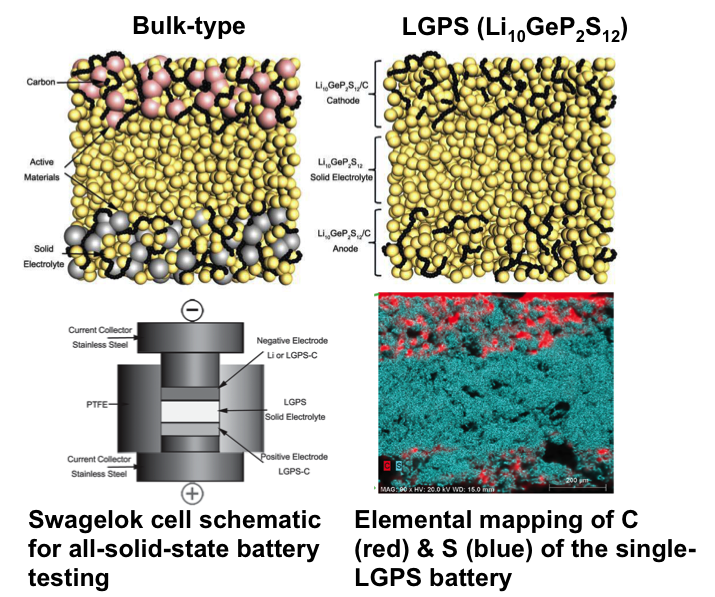
A proof of concept of a single material battery using LGPS (Li10GeP2S12) as the electrolyte, anode, & cathode. We demonstrate a remarkably low interfacial resistance due to improved interfacial contact, modification of interfacial interactions & suppression of strain/stress.
Significance and Impact
This novel single element approach can be broadly applied to other solid-state battery systems to benefits both safety and reliability in energy storage by addressing electrode-electrolyte interfacial resistance.
Research Details
- Electrochemical measurement of LGPS-C (LGPS:carbon 3:1 by wt.) electrodes were tested in coin cell using liquid electrolyte, establishing the Li-S/C component at 41% theoretical capacity as Li2S cathode, the Ge-S/C component at 80% theoretical capacity as GeS2 anode.
- The single-LGPS battery contains layer thickness of LGPS/C cathode, LGPS electrolyte, & LGPS/C anode as 222, 330 & 148 mm respectively.
References
F. Han, T. Gao, Y. Zhu, K.J. Gaskell, C. Wang, A Battery Made From a Single Material, Adv. Meter., 27 (23), 3475 (2015).
Summary
All-solid-state (ASS) Li-ion batteries are receiving increasing interest for energy storage systems because of the safety and reliability benefits by replacing volatile and flammable liquid electrolyte with nonflammable inorganic solid electrolyte. From the basic science perspectives, the use of ASS systems pose the very fundamental challenge of high interfacial resistance across the three distinctive components: an anode material that can reversibly lithiate/delithiate at a low potential, a cathode material that does the same at a high potential, and a solid electrolyte with high ionic but low electronic conductivity. Conventional bulk-like ASS LIB use three different materials due to these stringent different requirements.
Drawing from their collective past experiences and knowledge on sulfide chemistries as potential electrode and electrolyte materials for Li-ion batteries, NEES scientists explored a new revolutionary approach to the ASS energy storage challenge. They designed a proof-of-concept interface-free ASS battery by using a single sulfide-based solid electrolyte material, Li10GeP2S12 (LGPS). After mixing with carbon, the Li–S and Ge–S components of the LGPS could act as active centers for its cathode and anode performance in a way similar to the Li2S cathode and GeS2 anode, respectively. This single-LGPS exhibited a remarkably low interfacial resistance due to: (1) the improvement of interfacial contact, (2) the modification of the interfacial interactions, and (3) the suppression of the strain/stress at the interface.
The single-material battery concept provides a promising direction to address the most challenging interfacial problem in ASS Li-ion battery. It can also be broadly applied to other solid-state battery systems, beneficial to a high-power, high-energy, long-cycling all-solid-state battery. Additional implications of this concept include the fabrication of a nanobattery by introducing electronically conductive material on both the surfaces of the LGPS nanomaterials.
Acknowledgements
This work was supported by NSF & as part of EFRC NEES, and was performed at UMD.
Press Release
"For batteries, one material does it all" by Martha Heil, UMD NanoCenter
ALD Solid Electrolytes
Scientific Achievement
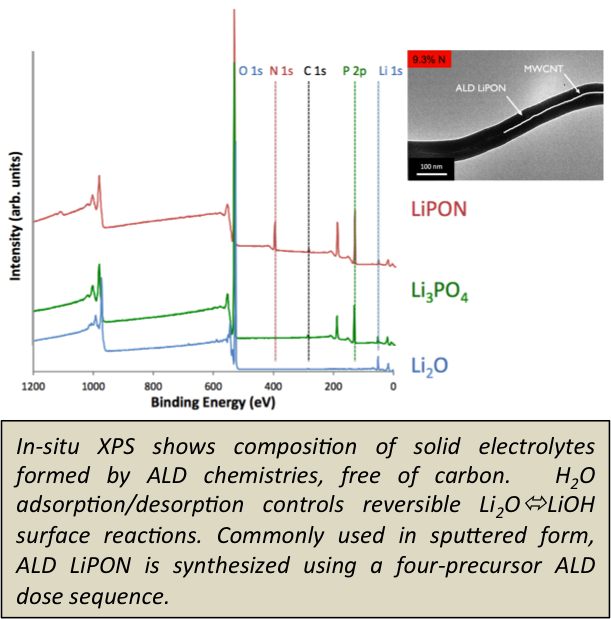
We have developed atomic layer deposition (ALD) processes for Li2O, Li3PO4, and LiPON as controlled solid electrolyte films, using in-situ processing & analysis to identify surface chemistry.
Significance and Impact
Chemical routes to thin solid electrolytes are needed to control film morphology and transport properties beyond the demonstrated limitations of sputtered materials. Solid electrolytes are a primary obstacle to solid state batteries and could be crucial to adoption of metal anode for beyond-Li-ion storage.
Research Details
- ALD precursors include Li tert-butoxide (LiOtBu), H2O, tri-methyl-phosphate (TMP), and plasma N2, depending on which solid electrolyte material is desired.
- In-situ XPS after ALD shows reversible LiOH <-> Li2O reaction involving H2O desorption above 240C. CO2 exposure leads to Li2CO3 formation, but otherwise all three solid electrolytes are formed carbon-free.
References
A.C. Kozen, A.J. Pearse, C-F Lin, M. Noked, G.W. Rubloff, Atomic Layer Deposition of the Solid Electrolyte LiPON, Chem. Mater., 27 (15), 5324 (2015); doi 10.1021/acs.chemmater.5b01654.
A.C. Kozen, A.J. Pearse, C-F Lin, M.A. Schroeder, M. Noked, S.B. Lee, G.W. Rubloff, Atomic Layer Deposition and in-situ Characterization of Ultraclean Li Oxide and Li Hydroxide, JPPC, 118, 27749 (2014); doi 10.1021/jp509298r.
Summary
LiPON (lithium phosphorus oxynitride) has been one of the most popular solid state electrolyte used for planar lithium ion microbatteries. As a physical deposition technique, reactive sputtering to form LiPON thin films onto planar surfaces has been demonstrated; however, such technique was shown to be rather inadequate for thin film deposition onto high aspect ratio 3D nanostructures – indeed, uniformity and conformity were major challenges. Motivated by our prior work on 3D solid state Li-ion nanobatteries, NEES scientists recently developed and demonstrated the first reported atomic layer deposition (ALD) process for LiPON thin film. We were able to take advantage of the unique integrated high-vacuum deposition surface characterization and battery assembly systems available in the ANSLab at University of Maryland, College Park, under the direction of Gary Rubloff.
Four precursors were used for the ALD process for Li2O, Li3PO4 and LiPON - lithium tert-butoxide (LiOtBu), H2O, trimethylphosphate (TMP), and plasma N2 (PN2), under conditions that are favorable for only certain substrate-precursor chemical reactions. Additionally, we demonstrated tunable nitrogen doping by using N2 plasma doses as a critical parameter. It was found that the LiPON ALD films over approximately 4.5% nitrogen are amorphous, whereas films with less than 4.5% nitrogen are polycrystalline.
Acknowledgements
Work was performed at UMD & supported by EFRC NEES.
Press Release
Nonuniform Si Loss in Nanowire Anodes during Li Cycling
Scientific Achievement
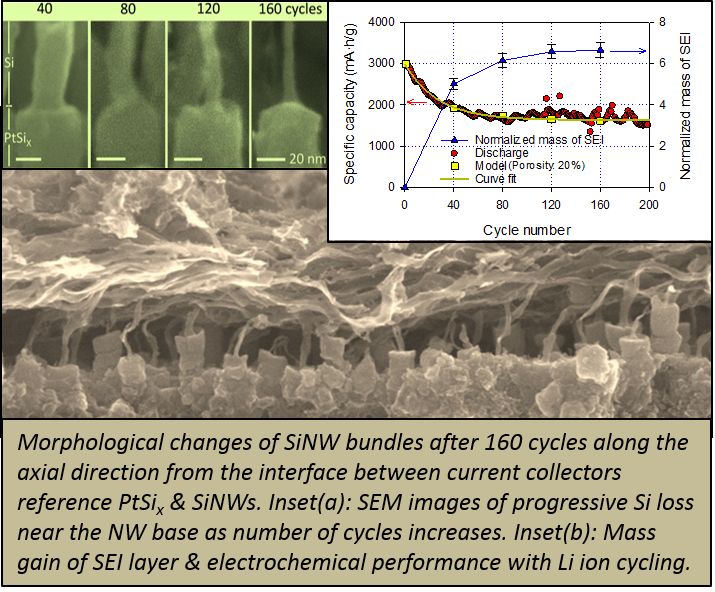
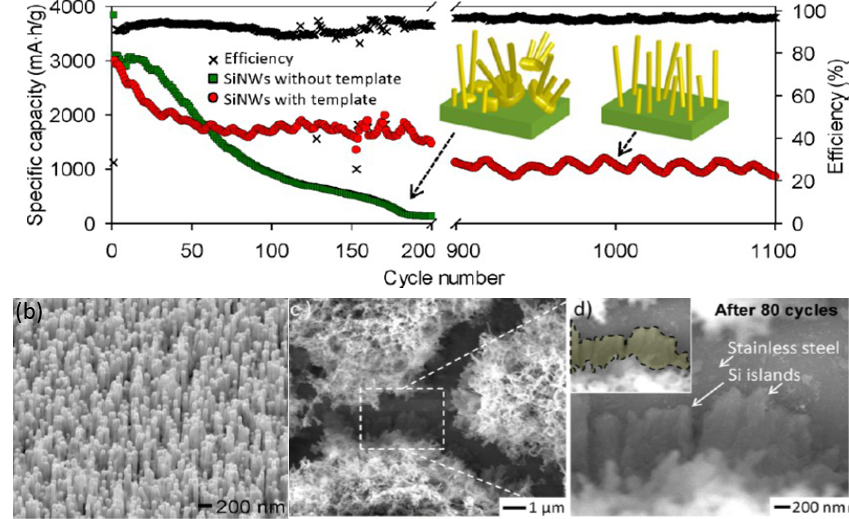
We observed for the first time Si loss from nanowires with cycling. This occurs preferentially, close to the current collector & is correlated with the growth of the solid-electrolyte-interphase (SEI) and capacity fading with charge/discharge cycling.
Significance and Impact
Results suggest that Si loss during cycling may contribute significantly to capacity fade. Spatial nonuniformities in nanowire designs may lead to predictable locations for accelerated degradation and failure.
Research Details
- Template growth was used to synthesize the SiNWs on a platinum silicide (PtSix) pedestal which does not undergo SEI formation during Li cycling, establishing a built-in reference diameter for the NWs.
- Nonuniform morphological changes along NW length were observed, with accelerated Si loss in diameter (0.1-0.5 nm/cycle) near the NW base (150nm from current collector) and less Si loss further from the base.
- Capacity reduction with cycling is correlated to both Si volume loss and SEI growth.
References
J. Song, J. Duay, E. Gillette & SB Lee, "The Reversible Anomalous High Lithium Capacity of MnO2 Nanowires", Chem. Communications, 50, 7352-7355 (2014) DOI: 10.1039/C4CC02001D.
Summary
Due to their high energy and power densities, silicon nanowires (SINWs) as anode materials in lithium-ion batteries are of great interest. However, their high surface-to-volume ratio is believed to contribute to fading in capacity retention during cycling due to solid-electrolyte-interphase (SEI) formation. Effort to establish a stable and continuous SEI layer as a protective layer is an active area of research.
For the first time, scientists at Nanostructures for Electrical Energy Storage (NEES), a DOE Energy Frontier Research Center (EFRC), were able to directly measure silicon loss from the SINWs during lithiation/delithiation cycles. By using platinum silicide pedestals template as a built-in reference, rapid initial reduction in SINW diameter width near the NW base was clearly visible & quantifiable. Researchers were able to accurately predict the measured decrease in specific capacity with SEI layer growth over the first 200 cycles. The results imply that prior to stabilization of the SEI layer, the size and evolution of individual SiNWs, near their interface with the metallic charge-collecting conductors, play a critical role in the long term capacity retention during cycling for SiNW-based anode materials.
Figure Inset (b): The mass of SEI layers is given for four samples and determined by measuring the mass of SiNW based anode materials before and after 40, 80, 120, and 160 cycles. The normalized mass of SEI was obtained by dividing the mass of SEI layers by pristine SiNW mass. Specific discharge capacity measurements were collected between 20 mV and 1.5 V at 0.5C in a SiNW-based half cell. Square symbols are the calculated results of a model of the specific capacity change with cycle number based on the loss of Si: solid yellow line is a curve fit to the model, C = 2987-1353 {1 - exp[-0.0369(cycle no. -1)]}. The 2987 mA h/g in the curve fit equation is the measured value of discharge specific capacity in the first cycle.
Acknowledgements
Work was performed at CINT, LANL & supported by EFRC NEES.
Precision Nanobatteries by the Billions
Scientific Achievement
Batteries formed inside nanopores provide a means to assess fundamentals of ion and electron transport in nanostructures for energy storage. By rational design for both transport components, these nanobatteries deliver their stored energy efficiently at high power (fast charge & discharge) and for extended cycling.
Significance and Impact
Results demonstrate that precise nanostructures can be constructed to test the limits of 3-D nanobatteries and that the smallest batteries to date show excellent power and cycling performance.
Research Details
- Each electrode includes an outer Ru nanotube current collector and an inner nanotube of V2O5 storage material to form an anode (prelithiated) & a cathode (pristine) separated by electrolyte.
- The capacity retention for is 95% at 5C and 46% at 150C compared to 1C values (24s charge-discharge cycle). At the 5C rate, 81% capacity is retained after 1,000 cycles between 0.2V and 2.8V.
References
C. Liu, E.I. Gillette, X. Chen, A.J. Pearse, A.C. Kozen, M.A. Schroeder, K.E. Gregorczyk, S.B. Lee, G.W.Rubloff, "An all-in-one nanopore battery array", Nature Nanotechnology Advance Online Publication 10 November 2014, doi: 10.1038/nnano.2014.247.
Summary
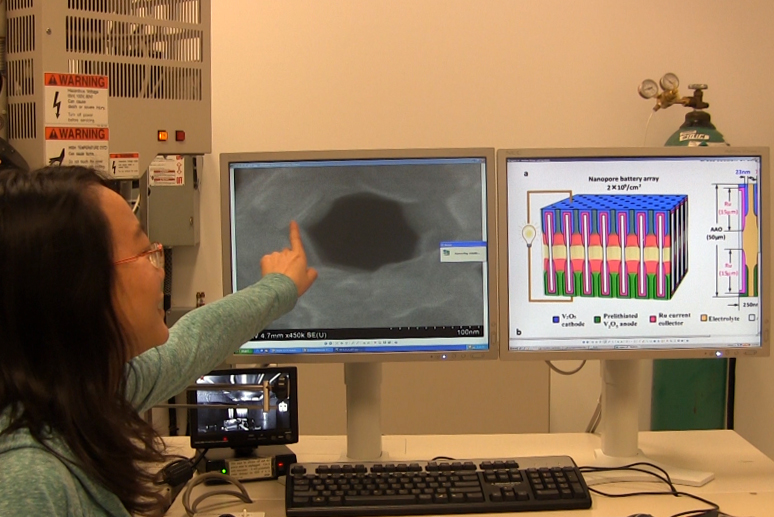
Nanostructured batteries, when properly designed and built, offer promise for delivering their energy at much higher power and longer life than conventional technology. To retain energy density, nanostructures (e.g. nanowires) must be paced into dense "nanostructure forests", producing 3-D nanogeometries in which ions and electrons must rapidly move. Researchers have built arrays of nanobatteries inside billions of ordered, identical nanopores in an alumina template to determine how well ions and electrons can do their job in ultrasmall environments. Up to a billion nanopore batteries could fit in a grain of sand. The nanobatteries were fabricated by atomic layer deposition to make oxide nanotubes (for ion storage) inside metal nanotubes for electron transport, all inside each end of the nanopores. The tiny nanobatteries work extremely well: they can transfer half their energy in just a 30 second charge or discharge time, and they lose only a few % of this after 1000 cycles. Researchers attribute this performance to rational design and well-controlled fabrication, achieving nanotubular electrodes to accommodate ion motion in and out, and close contact between the thin nested tubes to ensure fast transport for both ions and electrons.
Acknowledgements
Work was performed at CINT, LANL & supported by EFRC NEES.
News Article
Scaling limits for miniature all-solid-state Li-ion battery
Scientific Achievement
A miniature diagnostic model was fabricated using LiCoO2 cathode, ultrathin conformal LiPON electrolyte layer & α-Si anode shells in an all solid-state heterostructure nanowire Li-ion battery (NWLIB).
Significance and Impact
In-situ correlation of electrochemistry and structure during cycling reveals interfacial breakdown of solid electrolyte, providing key insights for future all-solid nanobatteries.
Research Details
- At 0.5-1.2 μm in diameter and up to 7 μm in length, the NWLIBs are the smallest complete secondary batteries realized to date.
- With electrolyte thickness in the 110 nm range, rapid self-discharge accompanied by void formation were observed, as onset of space-charge limited electronic conduction (SCLC) occurred.
- Detailed characterizations were carried out using multiple imaging techniques, coupled with correlative multivariate statistical analysis and tomography.
References
V. Oleshko etc., Nanoscale, 6, 11756-11768 (2014) DOI: 10.1039/c4nr01666a.
D. Ruzmetov etc., Nano Lett., 1, 505-511 (2012) DOI: 10.1021/nl204047z.
Summary
Nanostructures for Electrical Energy Storage (NEES) scientists designed model miniature all solid-state radial heterostructure nanowire Li-ion batteries (NWLIBs) composed of LiCoO2 cathode, an ultrathin conformal solid electrolyte layer LiPON, and amorphous Si anode shells. Sized 0.5-1.2 μm in diameter and up to 7 μm in length, these nanobatteries constitute a powerful engineering platform for diagnostics of nanoscale electrochemical processes in direct correlation to structural changes.
For the thinnest solid electrolyte layer ≈ 110nm, a rapid self-discharge along with void formation at the electrode/electrolyte interface occurred, indicating both electrical and chemical breakdown. The nanobatteries with LiPON thickness at 180 nm were able to maintain a potential above 2V for over 2 hours, showing substantial improvement. At these nanoscale dimensions, the onset of space-charge limited electronic conduction (SCLC) can drastically compromise the electrolyte stability.
We paid particular attention on the in-situ characterization of the nanoscale interfacial electrochemical & structural evolution during cycling, employing 3-D scanning & transmission electron microscopy (S/TEM), field-emission SEM and tomography techniques together with correlative multivariate statistical analysis. A detailed 3-D structural model was proposed based on this work, such as textured platelet-like LiCoO2 nanocrystallites around the void. This nanostructure is the result of using sputter deposition onto high aspect ratio vertical microrods and likely also contributes to the electrolyte breakdown.
Acknowledgements
This work was supported as part of EFRC NEES, NIST, and SNL.
Reversible anomalous high Li+ insertion
Scientific Achievement
For amorphous nanostructured materials in organic electrolyte, reversible Li
Significance and Impact
Electrochemical reaction mechanism of pseudocapacitance in MnO2 nanowires may involve additional reduction reactions with expanded voltage window, leading to higher charge capacity.
Research Details
- Inductively coupled plasma-atomic emission spectroscopy (ICP-AES) was used to probe counter-ion insertion.
- In aqueous electrolyte, the insertion ion is shown to be a combination of protons and cations.
- The electrochemical lithiation potential can go beyond 0V down to -0.6 V vs. Ag/AgCl.
- The Li ion insertion-deinsertion process is reversible as supported by ICP-AES & Raman spectroscopy.
References
J. Song, J. Duay, E. Gillette & SB Lee, "The Reversible Anomalous High Lithium Capacity of MnO2 Nanowires", Chem. Communications, 50, 7352-7355 (2014) DOI: 10.1039/C4CC02001D.
Summary
Nanostructures for Electrical Energy Storage (NEES) Researcher Sang Bok Lee at University of Maryland investigated the charge storage mechanism of manganese oxides (MnO2), a promising storage material for rechargeable lithium ion batteries (LIB) and supercapacitors. Here an inductively coupled plasma-atomic emission spectroscopy (ICP-AES) instrument was used to track the magnitude of counter-ion insertion as the voltage window is expanded for nanowire arrays of amorphous MnO2.
Contrary to the generally assumed 1:1 insertion ratio of Li ion per MnO2 unit, it was found that in organic electrolyte, the magnitude of lithium ion insertion was in fact greater than one, reaching a maximum ratio of 1.56 at -1 V. This result is 50% more than expected. Authors attributed it to the further reduction of manganese to the Mn2+ state beyond the reduction from the Mn4+ to Mn3+ states.
The process was also found to be reversible, evidenced by results of ICP-AES and Raman spectroscopy. Furthermore, lithium insertion goes below the traditional stopping point of 0 V vs Ag/AgCl for supercapacitors. Based on the findings here, the actual end point for the electrochemical lithiation in this system was around -0.6 V vs. Ag/AgCl that will lead to higher charge capacity of MnO2.
Acknowledgements
Work was performed at University of Maryland and supported by EFRC NEES.
Approaching limits of transparency and conductivity
Scientific Achievement
In situ electrical & optical measurements of Li intercalated ultrathin graphite demonstrated a figure of merit σdc/σopt = 1,400, approaching the limits of transparency & conductivity for a doped graphene system.
Significance and Impact
An in situ planar nanobattery design enables future understanding of electrochemical intercalation dynamics & correlated optoelectronic properties of 2-D nanomaterials.
Research Details
- Li intercalation simultaneously increases the DC electrical conductivity & optical transmission in the visible - transmission of 91.7% and a sheet resistance of 3.0Ω/sq were achieved for 19-layer LiC6, corresponding to a figure of merit σdc/σopt = 1,400, comparable to good metals.
- The observed optoelectronic properties are explained by the suppression of interband optical transitions & an intraband Drude conductivity near the interband edge.
References
W. Bao etc., Nature Comms., 5, 4224 (2014) DOI: 10.1038/ncomms5224.
Summary
A team of researchers from the University of Maryland, including Liangbing Hu from the Energy Frontier Research Center (EFRC), Nanostructures for Electrical Energy Storage (NEES), and Monash University in Australia has developed a nearly transparent, highly conductive ultrathin graphite sheet that can be used to create more efficient solar cells and highly sensitive touchscreens. The new material was introduced in the July 1, 2014 issue of Nature Communications.
While intercalating various species of molecules between few-layer graphene (FLG) to improve transparency has been done before, this is the first time an increase in both visible-range transmittance and conductivity has been observed simultaneously with the use of Lithium. Due to the unique band structure of graphene layer, intercalation in FLG shifts the Fermi level upward and suppresses interband optical transitions due to Pauli blocking.
The team was able to demonstrate a 91.7% transmission of visible light and a sheet resistance of only 3.0Ω/sq, which corresponds to a figure of merit σdc/σopt = 1,400, thereby achieving the highest combined performance among all continuous thin films.
Acknowledgements
Work was performed at UMD and supported in part by EFRC NEES, ONR MURI and NSF-CMMI.
News Article
Adding Lithium Boosts Transparency and Conductivity of Graphite
Capacity loss due to irreversible Li trapping in AlLi alloy
Scientific Achievement
Combining galvanostatic cycling with in situ microscopy, capacity loss in Al anode is shown to be caused by irreversible trapping of Li in the AlLi alloy formed on the exposed surface of Al.
Significance and Impact
Real time observation of charge-discharge cycling in a thin film solid state battery reveals degradation mechanism intrinsic to alloy formation & surface oxidation.
Research Details
- Real-time scanning electron microscopy and Auger spectroscopy were used.
- Electrochemical reaction Li + Al -> AlLi only occurs on anode surface due to strain.
- For a thin film, all-solid-state Li-ion battery (TFLIB) with Al anode, LiCoO2 cathode & N-doped Li3PO4 (LiPON) electrolyte, 90% capacity loss after 100 cycles was observed.
- The capacity fade is due to the blockage of Li & Al diffusion paths from the Li-Al-O alloy on the anode surface. The alloy formation is irreversible & is driven by surface reaction.
References
M.S. Leite, D. Ruzmetov, Z. Li, L.A. Bendersky, N..C. Bartelt, A. Kolmakov, A.A. Talin, J. Materials Chem A (2014) 2, 20552. DOI: 10.1039/c4ta03716b.
Summary
By combining real-time scanning electron microscopy in ultra-high vacuum with electrochemical cycling, scientists at Nanostructures for Electrical Energy Storage (NEES), a DOE Energy Frontier Research Center (EFRC), characterized and quantified the dynamic degradation of Al anodes in Li-ion all-solid-state batteries, a promising alternative to the Si anodes for ultra lightweight energy storage systems.
In the Si nanostructure systems, reducing the diameters or thickness to below 100nm can better accommodate volumetric strains due to lithiation/de-lithiation. In contrast, Al nanowires and films degrade more rapidly as dimensions become smaller, as observed by Hudak et al. This loss of capacity was attributed to the rapid loss of electrical conductivity due to fracturing.
Here, researchers found that the loss in battery capacity is directly related to the irreversible Li trapping in the AlLi alloy formations on the anode surface, which remain in electrical contact with Al during cycling. The mechanism is based on the surface oxidation of AlLi causing the blockage of Al and Li diffusion pathways, necessary for the breakdown of AlLi alloy at room temperature, resulting in Al-Li-O alloy irreversibility.
Acknowledgements
Work was performed at UMD, NIST & SNL-CA, partially supported by EFRC NEES.
Rectification of Surface Charge in Single Conical Nanopore
Scientific Achievement
Monovalent cations can modulate the effective surface charge density & influence cation mobility within conical nanopores. Experimental results are explained by all-atom molecular dynamics simulations.
Significance and Impact
For a quantitative description of ionic transport within pores at the nanoscale, atomic details in the model systems is needed to capture ionic current properties by different monovalent cations.
Research Details
Current-voltage curves through single asymmetric nanopores were recorded in 3 electrolytes, LiCl, NaCl & KCl.
In contrast to a continuum model prediction based on bulk behavior, highest degree of rectification was shown for KCl & lowest for LiCl.
Experimental observations were explained by all-atom molecular dynamics simulations, showing differential cation bindings to charged groups on the pore walls.
Summary
Functioning of nanoforest architectures is dependent on the ionic distributions inside the nano-constrictions, determined by the access of ions as well as ionic interactions with charged surfaces. A model system of single conically shaped nanopores provided insight into which interactions of ions with surfaces are important for ionic transport at the nanoscale.
NEES researchers at University of California, Irvine, recorded the current-voltage curves through single asymmetric nanopores were recorded in three electrolytes, LiCl, NaCl, and KCl. In contrast to the predictions of a continuum model based on the Poisson-Nernst-Planck equations, rectification degree of the pores was the highest for KCl, and the lowest for LiCl. The currents recorded in LiCl as the bulk electrolyte were also several times lower than predicted from relative bulk conductivities of KCl and NaCl. The experimental observations were explained by all-atom molecular dynamics simulations, which revealed differential binding between Li+, Na+, and K+ ions and charged groups on the pore wall, resulting in changes to both the effective surface charge of the nanopore and cation mobility within the pore.
This study alerts researchers that monovalent cations can modulate surface charge density of surfaces and influence ionic transport in pores at the nanoscale. Consequently, quantitative description of ionic transport might require introducing atomistic details of some elements of the system.
References
Trevor Gamble, Karl Decker, Timothy S. Plett, Matthew Pevarnik, Jan-Frederik Pietschmann, Ivan Vlassiouk, Aleksei Aksimentiev, and Zuzanna S. Siwy, "Rectification of Ion Current in Nanopores Depends on the Type of Monovalent Cations: Experiments and Modeling", J. Phys Chem C, 118, 9809-9819 (2014) DOI: 10.1021/jp501492g
Conductive Metal-Organic Frameworks (MOFs)
A. Talin (SNL) - Thrust E
Scientific Achievement
Tetracyanoquinodimethane (TCNQ) molecules create an electrically conducting path through the Cu3(BTC)2 MOF structure.
Significance and Impact
A strategy in which nanopores are infiltrated with redox-active, conjugated guest molecules was developed, achieving MOFs with tunable, air-stable electrical conductivity increase over six orders of magnitude.
Research Details
- Conductivity arises from TCNQ guest molecules bridging the binuclear copper paddlewheels in the framework, leading to strong electronic coupling between the dimeric Cu subunits.
- By altering the exposure time to TCNQ, the magnitude of the conductivity could be controlled.
Summary
Scientists from Nanostructures for Electrical Energy Storage, a DOE Energy Frontier Research Center, have added something new to a family of engineered, high-tech materials called metal-organic frameworks (MOFs): the ability to conduct electricity. This breakthrough-conductive MOFs-has the potential to make these already remarkable materials even more useful, particularly for applications that require charge transport, such as super capacitors, battery electrodes, and electrocatalysts.
MOFs are three-dimensional crystalline materials with nanoscale pores made up of metal ions linked by various organic molecules. These frameworks have huge surface areas but are typically poor electrical conductors (in this case, a well-known copper containing MOF known as HKUST-1). The guest molecules introduced is tetracyanoquinodimethane (TCNQ), another insulating material in itself. But in combination with other organic molecules or metal ions such as copper, TCNQ forms electron-conducting charge-transfer complexes.
NEES Scientists infused and bound electron-sharing molecules into MOF thin films to create a material that is stable in air and approximately a million times more conductive than the unaltered MOF. Based on several spectroscopic experiments, the guest molecules serve two important purposes: they create additional bridges between the metal ions-copper, in this case-and they accept electrical charges.
Lithographically Patterned Capacitor with Ultra-long Nanowires (NWs)
Scientific Achievement
Interdigitated capacitors were made of Au/MnO2 NWs fabricated using lithographically patterned nanowire electrodeposition (LPNE). Each of the 750 NWs is 2.5 mm in length in a core-shell configuration.
Significance and Impact
Hybrid supercapacitors consisting of ultra-long Au/MnO2 NWs were shown to retain 90% of the capacitymax for 6,000 cycles while simultaneously delivering high power and high capacity.
Research Details
Capacitor contains 750 NWs 2.5 mm in length, each with a Au NW core (40 nm X ?200 nm) encapsulated within a hemicylindrical shell of d-phase MnO2 of controllable thickness, were patterned onto a planar glass surface.
Max power density of 165 kW/kg coupled with max energy density of 24 Wh/kg was demonstrated.
Summary
Building on their previous work developing the horizontal Au@d-MnO2 nanowires core-shell capacitor system using lithographically patterned nanowire electrodeposition (LPNE), NEES researchers at University of California, Irvine, now expanded the system to arrays of 750 nanowires that are each 2.5 mm in total length. In their work with MnO2 shell thickness of 68 nm, they demonstrated the capability to produce high power density (Pmax at 165 kW/kg) and high energy density (Emax at 24Wh/kg). A cycle life up to 6000 cycles retaining 90% of the maximum capacity was demonstrated at 100 mV/2 across a 1.2 V window.
These nanowires each consists of a gold nanowire core encapsulated within a hemicylindrical shell of d-phase MnO2 with thickness 60-220 nm. They are lithographically patterned in an interdigitated horizontal pattern onto glass. The sensitivity of the capacity to degradation processes are cumulative with increasing nanowire length, caused by possible failure modes such as nanowire scission, delamination of MnO2 shell from the gold core, and dissolution of MnO2.
These data support the conclusion that durable, ultrahigh power density capacitors can be fabricated based upon millimeter-scale metal core?metal oxide shell nanowire arrays.
References
W. Yan, M. L. Thai, R. Dutta, X. Li, W. Xing and R. Penner, "A Lithographically Patterned Capacitor With Horizontal Nanowires of Length 2.5 mm" ACS Appl. Mater. Interfaces (2014) DOI:10.1021/am500051d
Charge-Transfer Resistance of Carbon Nanotube (CNT) Interfaces
P.G. Collins Group (UCI) - Thrust A
Scientific Achievement
Interfacial charge-transfer resistivity of CNTs is found to be as low as 30 m? cm2 and approximately 50X smaller than Pt or HOPG surfaces. This ultra-low resistivity arises from CNTs efficient utilization of surface area within 3D electrochemical composites, an effect that had previously been under-estimated by a factor of 20 in models that assumed a simple proportionality to area A.
Significance and Impact
This work provides the first complete model for CNT charge-transfer and design rules for 3D composites that include them. Compared to other electrodes, ultra-small, filamentous CNT networks have unique benefits for high-power cycling of energy storage composites.
Research Details
- Individual single-walled nanotubes (SWNTs) coated with MnO2 provide an ideal model system to probe charge/discharge interfacial charge transfer and impedances at the nanoscale.
- SWNTs, MWNTs, and Pt all behave as ultramicroelectrodes with area-normalized interface resistance Ri = (90 +- 10 ?m ) A-1/2 that is independent of surface chemistry, defects, and bandstructure.
- The unusual A-1/2 scaling indicates that SWNT electronic impedances are tightly coupled to ionic transport in the MnO2.
Summary
In principle, heterogeneous composites provide opportunities to enhance capacity and power in energy-storage devices by taking advantage of the best properties of different materials. Recently, many experimental papers have reported surprising improvements in power delivery from charge-storage materials mixed with nanocarbons like carbon nanotubes or graphene.
Using a unique model system of an individual single-walled carbon nanotube (SWNT) loaded with a thin film of MnO2, scientists at NEES EFRC have explained the main cause of the enhancements caused by these nanocarbons. SWNTs obey unusual areal scaling rules that are well established for ultramicroelectrodes but not usually applicable to 3D composites. When optimally dispersed, SWNTs are super-efficient in the utilization of their distributed area, whereas a conventional analysis would incorrectly underestimate SWNT charge-transfer impedances by factors of 20 or more. New design rules from the NEES EFRC work surprisingly show that the benefits of SWNTs are not related to intrinsic conductivity, bandstructure, or surface chemistry, and they re-emphasize the importance of coupling between electronic and ionic transport in nanoscale systems.
References
B.L. Corso, I. Perez, T. Sheps, P.C. Sims, O.T. Gu?l, and P.G. Collins (2014). "Electrochemical Charge-Transfer Resistance in Carbon Nanotube Composites" Nano Letters. DOI: 10.1021/nl404349g
Pioneering Ionic Current Probe of MnO2 Mesorods in Single Nanopore
Siwy and Lee Research Groups - Thrust A
Scientific Achievement
For the first time, researchers have applied ionic current to directly probe both structural and electrochemical characterizations of nanoporous manganese oxide mesorods deposited in a single polymer pore. The present results showed the existence of nanovoids with effective diameters <5nm, which carried negative surface charge with metal cation selectivity.
Significance and Impact
Understanding ion transport mechanisms in confined space of metal oxide materials can have a revolutionary impact in electrochemical energy storage technology, as applied to lithium ion batteries and supercapacitors. The reported novel method using ionic current provides a valuable probe for charge polarity and species-selective transport in electrode nanomaterials.
Research Details
- Resistance and current measurements supported a meshlike porous character for the deposited MnO2.
- Current saturation experiments at low electrolyte concentration showed the existence of nanovoids with effective diameters less than 5nm.
- Reversal potential measurements under salt concentration gradient indicated negatively charged surface area and selectivity for metal cations such as Li+ but not protons.
Summary
Research groups at Nanostructures of Electrical Energy Storage (NEES) EFRC applied ionic current as a novel method to probe the nanoporous structures and physical properties of MnO2 deposited as mesorods inside a single pore in a polymer film of polyethylene terephthalate (PET). Similar approach had been applied previously to polymer nanopores and biological channels, but not in application to metal oxide materials such as MnO2. Although data on characterization of manganese oxide in bulk are available, little information is forth coming on its transport mechanism under confined structural configurations, as in the case of the present study. Resistance and current measurements supported a meshlike porous character for the deposited MnO2. Additional current saturation experiment at low electrolyte concentration confirmed that the effective diameters of the voids are in nanometer range. Under cross-membrane salt concentration gradient, reversal potential measurements indicated that the nanovoids are negatively charged and are selective for metal cations such as Li+, but not protons. Observed nonlinear current-voltage curves suggested an asymmetrical nanopore structures with directional selectivity. These results laid the foundation for future investigation of the MnO2 nanotructures during charging/discharge cycles.
References
T. Gamble, E. Gillette, S.B. Lee and Z.S. Siwy, "Probing Porous Structure of Single Manganese Oxide Mesorods with Ionic Current" The Journal of Physical Chemistry C (2013), 117 (47), pp 24836-24842. http://pubs.acs.org/doi/pdf/10.1021/jp408107z
Nanoglue for Hybrid Nanostructures in Na Ion Anodes
Liangbing Hu Group (UMD)
Scientific Achievement
In situ TEM studies show that atomic layer deposition (ALD)-Al2O3 coating forms an artificial solid electrolyte interface (SEI) layer, which robustly anchors Sn nanoparticles (SnNPs) to carbon nanofibers (CNF) and undergoes volume changes synergistically with the SnNP core during sodiation cycling.
Significance and Impact
Highly conformal coatings offer mechanisms for robust binding of nanoparticle active storage material to current-collecting substrates, demonstrated here for ALD-Al2O3 to bind Sn nanoparticles to carbon fibers.
Research Details
- Na-Al-O layer formed irreversibly from a 3-5nm SnO2 sub layer & ALD-Al2O3 coating in initial surface sodiation.
- Coin-cell battery using liquid electrolyte showed stabilized specific capacity of 650 (vs 110) mAh/g after 40 cycles with (vs without) ALD-Al2O3 coating.
- Finite element simulations: Na-Al-O layer (thickness-dep) delays debonding initiation & allows capacity retention beyond interfacial delamination at 67% volume expansion.
Summary
Combined with tin's high theoretical specific capacity, Na ion batteries (NIBs) have increasingly become an attractive candidate for grid-scale energy storage due to its low cost and abundance. But as Si is for Li ion batteries, Sn experiences huge volume expansion (420%) upon sodiation, a grand challenge for both structural and cycle stability during charging/discharging. Researchers at Nanostructures for Electrical Energy Storage (NEES) EFRC have conducted a real time mechanistic characterization of atomic-layer-deposition Al2O3 (ADL-Al2O3) coatings on the hybrid nanostructure anode (SnNPS@CNF) during sodiation/desodiation.
In situ TEM electrochemical tests demonstrated the irreversible formation of Na-Al-O layer as an artificial solid electrolyte interface (SEI), acting as an ion conductive nanoglue that deforms coherently in synch with volume expansion of the encased nanoparticle core after repeated cycling. In coin-cell battery made from ALD-Al2O3 anode materials, a charge capacity of 650 mAh/g was maintained without capacity fade for 40 cycles, compared to 110 mAh/g of the bare SnNPs@CNF. Finite Element Method simulations supported the observation that Na-Al-O layer mechanically protects the contact between SnNPs and CNF during volume expansion, even after initiation of debonding.
Reference
Xiaogang Han, Yang Liu, Zheng Jia, Yu-Chen Chen, Jiayu Wan, Nicholas Weadock, Karen J. Gaskell, Teng Li and Liangbing Hu, Nano Letters (2014) 14, 139-147. DOI: 10.1021/nl4035626
Si Nanowire Anodes with Long Cycle Lives
S. Tom Picraux Group (LANL)
Scientific Achievement
Nanoporous AAO template has been used to guide VLS growth of Si nanowires and prevent Si island formation by reaction with underlying metal collector, yielding excellent cycle life (> 1100) and specific capacity (1000 mAh/g) for high density SiNW arrays.
Significance and Impact
Achieving viable nanostructured electrode arrays requires careful attention to all relevant reaction pathways and 3-D design.
Research Details
- High density SiNW forests were deposited on stainless steel using bottom-up vapor-liquid-solid growth by chemical vapor deposition through AAO templates containing high density of sub-100nm nanopores.
- Specific capacity measurements & SEM images show that elimination of milli- & microscale Si underlayer islands allows stable SiNW-current collector contacts during cycling, retaining Si's high charge capacity.
Summary
Interests in silicon's high theoretical capacity (4200 mA-h/g) as an anode in lithium-ion batteries and the accompanied challenge of its huge volume expansion (~300%) during charge/discharge cycling, have driven research effort into high density one-dimensional Si nanomaterials. Although the use of nanoscale Si materials allows lateral relaxation and reduces mechanical stress of the Si electrodes, cycle stability >50 under high charging rates has yet to be realized, a crucial step toward industrial battery application. Scientists at Nanostructures for Electrical Energy Storage (NEES) EFRC have successfully improved cycle stability to >1100 while retaining 1000 mA-h/g specific capacities under high cycle rates (10C) for Si nanowires (SiNW) as Li-ion anode.
They discovered the existence of underlayer Si islands at the interface of the SiNW and the current collector, as an auxiliary deposits during chemical vapor deposition (CVD) synthesis process. SEM images showed cracks in these islands that prevented retention of specific capacity beyond 200 cycles, due to disruption of electrical contact between SiNW and current collector. Modifications in the bottom-up, vapor-liquid-solid (VLS) growth process employing anodized aluminum oxide (Al2O3) templates containing a high density of sub-100 nm nanopores eliminated the underlayer Si island formation.
Reference
Jeong-Hyun Cho and S. Tom Picraux, Nano Letters (2013) 13, 5740-5747. http://dx.doi.org/10.1021/nl4036498.
Hoop-Strong Nanotubes for Battery Electrodes
Scientific Achievement
Chemically inert Ni coating outside Si nanotubes (NTs) constrains Si to expand inward upon lithiation, enhancing structural stability and charge/discharge cyclability.
Significance and Impact
Functional coatings can prevent structural instability while enhancing electron transport to exploit Si as high capacity nanostructured anode.
Research Details
- In-situ TEM shows outward expansion of Si NTs if uncoated or with native oxide, leading to structural instability of Si and solid-electrolyte-interphase (SEI) during repeated cycling.
- Ni outer coating of 16 nm prevents outer surface expansion, forcing lithiation-induced expansion inward.
- Ni-coated SiNTs show dramatically better capacity retention (85% at 100 cycles)
Reference
K. Karki, Y. Zhu, Y. Liu, C.-F. Sun, L. Hu, Y. Wang, C. Wang, and J. Cumings. "Hoop-Strong Nanotubes for Battery Electrodes." ACS Nano (2013) DOI: 10.1021/nn403895h
Interface and Bandgap Engineering at the Nanoscale
Scientific Achievement
First direct observation that radial hetero-structuring can completely suppress the commonly observed surface insertion of Li ions, and can exclusively induce axial lithiation.
Significance and Impact
Interface and bandgap engineering can be utilized to control ionic transport/insertion at the nanoscale, a potential new tool to control volume expansion of high-energy anode materials.
Research Details
- Deposition of a conformal, epitaxial, ultrathin (~1 nm) Si shell on Ge NWs suppresses surface Li+ insertion and induces axial lithiation along the <111> direction in a layer-by-layer fashion.
- Pure axial lithiation on Ge/Si core/shell NWs showed Li+ ions do not penetrate the ultrathin surface Si shell.
- Core-shell lithiation was observed on pure Ge nanowires (NWs) indicating inward diffusion from surface to core.
References
Yang Liu, Xiao Hua Liu, Binh-Minh Nguyen, Jinkyoung Yoo, John P. Sullivan, S. Tom Picraux, Jian Yu Huang, and Shadi A. Dayeh, "Tailoring Lithiation Behavior by Interface and Bandgap Engineering at the Nanoscale", Nano Letters, 13, 4876-4883 (2013) DOI: 10.1021/nl4027549
Summary
This work presents the first direct observation of the dramatic interfacial effect on ionic transport at the nanoscale. This is also the first demonstration that the lithiation behavior of a nanostructure can be controlled by interface and bandgap engineering, a potential tool to minimize mechanical degradation and to improve battery performance.
Deposition of a conformal, epitaxial and ultrathin (down to ~1 nm) silicon (Si) shell on germanium (Ge) nanowires can completely suppress the commonly observed surface insertion of Li ions in all reported nanoscale systems to date. The Ge/Si core/shell nanostructure induces a purely axial lithiation along the <111> direction in a layer-by-layer fashion. The presence of the Si shell slows down the lithiation reaction at the surface and forms a chemical potential barrier that blocks Li ion diffusion through the shell.
Diagnosing Nanoelectronics with Electron Holography (EH)
Scientific Achievement
Using off-axis electron holography (EH), we made a direct observation of the electric potential distribution in the vicinity of a single carbon nanotube (CNT). The uneven resistivity of different contacts causes an asymmetric EH phase shift.
Significance and Impact
EH, combined with finite element calculations, offers a unique and precise method to identify & quantify the electrostatic potential drops across the metal contacts at the interface and along the length of the nanotube, with a spatial resolution of 10 nm or less.
Research Details
- Prototype device consists of a CNT connecting with two closely spaced contacts.
- Multiwalled nanotubes (MWNTs) were used, synthesized by chemical vapor deposition, with diameters ~50 nm and lengths up to a few µms.
- COMSOL Multiphysics calculations using a potential difference model suggest one bad contact at the ground electrode, confirmed by the experimentally observed image profile.
References
Kai He and John Cumings, "Diagnosing Nanoelectronic Components Using Coherent Electrons" Nano Letters (2013) 13, 4815-4819 DOI: 10.1021/nl402509c
Work was performed at University of Maryland.
Summary
For detecting defective contacts in nanoelectronic devices, external transport measurements often yield unsatisfactory results. Microscopic characterization, such as electron beam-induced current imaging can provide locations in more detail, but without a quantifiable electrostatic potential profile. To solve these problems, investigators from EFRC-NEES demonstrated that off-axis electron holograph (EH), which utilizes coherent electrons in a transmission electron microscope (TEM}, in combination with finite element calculations can be a powerful technique to provide direct spatial details of the potential at the nanometer scale. The system studied was a single carbon nanotube (CNT) with two closely-space electrical contacts, as a prototype structure for nanoelectric devices. Two different resistive contacts give rise to asymmetric features of the phase shift. When combined with finite element calculations (COMSOL Multi physics software with a potential difference model), the results demonstrated the ability to separately observe the electrostatic potential drops across the metal contacts and the interface, and along the length of CNT itself. The technique is extensible to a wide array of important nanoelectronic systems.
Energy Textile from Weavable High-Capacity Electrodes
YuHuang Wang Group (UMD)
Scientific Achievement
A highly scalable process was developed to produce a mechanically robust and electrically conductive Si-carbon nanotube (CNT) composite yarn, with discharge capacity five times that of graphite anodes.
Significance and Impact
NEES researchers have taken a further step to translate their scientific advance in hybrid Si@CNT nanostructures into fabric-like form factors amenable to evaluation as prototype battery technology.
Research Details
- Vertically aligned CNT arrays (50 nm in diameter,750 ?m in length) were spun into a porous yarn, layered with a-Si via low pressure CVD at Si:CNT mass ratio of 0.63.
- Si-CNT composite yarn showed a discharge capacity of 2200 mA h/g based on the Si mass, in the first 10 cycles with a cutoff of 0.1-1.0 V.
- Mechanically durable, flexible, scalable, with high electrical conductivity
- Fabrication control on porosity (twisting force) & Si mass
Summary
Adopting from textile technology, scientist at NEES EFRC designed and synthesized a Si-carbon nanotube (CNT) composite yarn that demonstrates a multitude of materials qualities desirable for electrical energy storage. It is mechanically strong, flexible, and highly scalable and possesses high electrical conductivity. A Li-storage capacity as high as 2200 mA h/g based on the Si mass in the first 10 cycles with a cutoff of 0.1-1.0 V was achieved, five times higher than that of the typical graphite electrodes. This high capacitance also exceeds previous reports from fabrication of supercapacitor yarns by electrodeposition using MnOx as the active materials.
Vertically aligned CTN arrays (each CNT approximately 750 ?m in length and 50 nm in diameter) grown by chemical vapor deposition (CVD) were spun into a yarn, followed by low pressure CVD of amorphous Si at a Si:CNT mass ratio of 0.63. The loading of active material Si per area for this yarn is ?2.5 mg/ and can be controlled by the growth time for Si. The porosity of the yarns can be controlled by cm2 adjusting the twisting force during the spinning process. The resulting yarn is highly porous, with ability to accommodate the volume expansion of Si upon electrochemical charging.
Reference
Chuan-Fu Sun, Hongli Zhu, Edward B. Baker III, Morihiro Okada, Jiayu Wan, Adrian Ghemes, Yoku Inoue, Liangbing Hu, YuHuang Wang Nano Energy (2013) 2, 987. http://dx.doi.org/10.1016/j.nanoen.2013.03.020
Real Time Observation of Breathable Silicon Beads on a Robust Carbon Nanotube String
YuHuang Wang's research group - Thrust B
Scientific Achievement
Researchers have built upon the heterogeneous carbon nanotube (CNT) as the current collector and Si as the ion storage material of ultrahigh capacity through selective chemical functionalization of the Si-CNT interface layer. A stable silicon nanobeads on a CNT structure was formed that radially swells and shrinks without cracking while maintaining electrical connectivity during lithiation/delithiation cycling. Chemical functional groups on the Si/C interface localize, separate, and anchor the beads, making Si's high energy storage capacity attainable.
Significance and Impact
Interfacial structural instability is a long-standing challenge in lithium ion battery anodes where silicon expands ~300% in volume during lithiation/delithiatin cycling. Studies here demonstrated that chemically controlled Si-Carbon nanotube interface can accommodate the huge volume change during lithiation/delithiation cycling, with stable structural integrity (no cracking) and intact electrical conductivity. This is a scientific breakthrough to harness silicon's potential for ultrahigh capacity as an anode material.
Summary
The Nanostructures for Electrical Energy Storage (NEES) EFRC investigates how the structure of materials at the nanoscale affects electrical energy storage. By growing silicon into the geometry of anchored beads on a carbon nanotube string, researchers created a nanostructure that can withstand significant radial expansion during lithiation/delithiation cycles without cracking.
Earlier NEES work reported that silicon nanoparticles under the critical diameter of 150 nm did not fracture when lithiated (DOI: 10.1021/nn204476h). Building on work that confined the propagation of functional groups on carbon nanotubes (DOI: 10.1038/ncomms1384), researchers grew silicon beads 200 nm in diameter that were anchored on carboxylic acid functional groups attached to the CNT. As observed by In situ TEM, cracks formed during charging and discharging in the tubular core-shell nanostructures but not in the functionalized beaded-string nanostructures. DFT and FEM computations revealed that in both cases tensile stresses developed in the unlithiated silicon due to the large volume expansion in the lithiated silicon phase, but strong covalent bond between the carboxylic acid function group and silicon prevented the silicon beads from cracking. These findings provide important new insights in the synthesis of high performance Si electrodes, laying a foundation for the next generation lithium ion batteries.
Research Details
- Each silicon bead of 200 nm in diameter was anchored on carboxylic acid functional groups attached to the CNT surface.
- During lithiation, the lithiated-silicon phase grows starting both from the outer bead surface and from the CNT-silicon interface.
- In situ TEM observation showed that cracks formed in the tubular core-shell nanostructures but not in the functionalized beaded-string nanostructures during charging and discharging cycling.
- DFT and FEM computations revealed that in both cases tensile stresses developed in the unlithiated silicon due to the large volume expansion in the lithiated silicon phase, but strong covalent bond between the carboxylic acid function group and silicon prevented the silicon beads from cracking.
References
Chuan-Fu Sun, Khim Karki, Zheng Jia, Hongwei Liao, Yin Zhang, Teng Li, Yue Qi, John Cumings, Gary W. Rubloff, and YuHuang Wang, "A Beaded-String Silicon Anode" ACS Nano (2013), 7, pp 2717-24. http://dx.doi.org/10.1021/nn4001512
Shunliu Deng, Yin Zhang, Alexandra H. Brozena, Maricris Lodriguito Mayes, Parag Banerjee, Wen-An Chiou, Gary W. Rubloff, George C. Schatz & YuHuang Wang, "Confined Propagation of Covalent Chemical reactions on Single-Walled Carbon Nanotubes" Nat Commun (2011) 2, p382. http//dx.doi.org/10.1038/ncomms1384
Lithium-Assisted Electrochemical Welding in Silicon Nanowire Battery Electrodes
Thrust B
Accomplishment
- Inside a TEM, the researchers crossed two silicon nanowires connected to a common substrate and touched the free end of one wire to lithium metal with a LiO2 oxide coating. With an applied bias to the substrate, both nanowires lithiated and fused, creating a lithium-ion-conducting region between them.
- Applying force to the cantilevered nanowires with the probe tip, the researchers estimated the shear strength of the node. Their analytical models gave the minimum shear strength to be 200 MPa, which compares to the strength of stainless steel (~205 MPa) and ceramic silicon carbide (~200 MPa), and a finite-element model found 308 MPa.
- The researchers proposed a kinetic driving force for the fusion. During lithiation, lithium ions bind with the surface silicon atoms on both wires simultaneously, creating metastable Li-Si bonds. During delithiation, the Si-Li-Si bonds break, and neighboring surface Si atoms bond to each other and fuse the nanowires together.
Significance
- The formation of fused regions between silicon nanowires is a critical first step toward self-healing networks of silicon and energy storage materials that may otherwise crack and lose contact with a current collector during charging and discharging.
- The room temperature method for creating the nodes is a facile method for controlling the number and location of fused regions between wires. Tailoring architectures of nanowire networks could provide a platform for further probing energy storage properties of nanostructures.
Reference
K. Karki et al., Lithium-Assisted Electrochemical Welding in Silicon Nanowire Battery Electrodes. Nano Letters 12, 1392 (2012/03/14, 2012). (coauthors: Karki, Khim; Epstein, Eric; Cho, Jeong-Hyun; Jia, Zheng; Li, Teng; Picraux, S. Tom; Wang, Chunsheng; Cumings, John) DOI: 10.1021/nl204063u
MnO2-Gold Nanowires with Ultra-high Charge Storage
R Penner Group (UCI) - Thrust A
Scientific Achievement
MnO2 nanowire electrodes with gold cores show ultra-high charge storage for 1000 charging and discharging cycles. Controlling the structure down to 2 nm scale increased the specific capacity, and employing a dry electrolyte greatly increased cycle stability. The nanowires can precisely measure MnO2 electrochemical properties without ohmic drops, which would occur in real battery electrodes. The mesoporous-MnO2 nanowires synthesized here showed a hybrid ultra-high specific capacity of 1020 F/g at 5 mV/s.
Significance and Impact
Controlling structure at the nanoscale unlocks nearly the full theoretical specific capacity from two of three storage mechanisms in MnO2. The present design of core/shell nanowires allows researchers to partially decouple the mechanisms that contribute to the observed ultra-high capacity, making it feasible to further increase the capacity, rate, and cycle stability in MnO2 and other charge storage materials.
Research Details
- The LPNE (lithographically patterned nanowire electrodeposition) technique deposited gold current collector nanowires 40 nm tall and 150-250 nm wide with MnO2 shells 50-250 nm thick. The porous nanowires were 0.1 - 1 cm long and were made of 2 nm-thick fibrils.
- Electrochemical measurements were taken with 1.0 M LiClO4 in dry acetonitrile. The dry electrolyte prevents Mn2+ from dissolving out of the material and degrading it.
- Because fibrils are so small, all Mn ions are close to surfaces and therefore can contribute to multiple charge storage mechanisms.
Summery
The Nanostructures for Electrical Energy Storage (NEES) EFRC investigates precision nanoparticles, nanowires, nanotubes, and nanometer-thick films to understand how the structure of materials affects charge storage mechanisms. Most reported nano-MnO2 electrodes show specific capacity values of 200-600 F/g, with a few reports up to 1380 F/g. The mesoporous-MnO2 nanowires synthesized here show hybrid ultra-high specific capacity of 1020 F/g at 5 mV/s. Cycle stability of this capacity up to 1000 cycles is achieved using dry acetonitrile electrolytes to eliminate dissolution of MnO2 during cycling.
The charge storage in MnO2 electrodes occurred via two faradaic and one nonfaradaic mechanisms. Electron transfers between ions in the electrolyte and Mn ions on the surface of MnO2 occur in faradaic pseudocapacitance mechanism. For the faradaic insertion mechanism, the electrolyte ions diffuse into the bulk MnO2 materials for the oxidation-reduction reactions to occur, which is the dominant charge storage in batteries. The one nonfaradaic charge storage in MnO2 occurs from double-layer capacitance at interface, which is the dominant charge storage in supercapacitors.
Using variable dependency of voltammetric current on potential scan rates, researchers were able to deconvolute insertion vs. noninsertion capacitances. They found that the high specific capacity in thin-shell MnO2 nanowires is largely due to changes in the faradaic insertion capacity, as it is rate-limited by cation diffusion in MnO2.
Reference
W. Yan, J. Y. Kim, W. Xing, K. C. Donavan, T. Ayvazian, R. M. Penner "Lithographically Patterned Gold/Manganese Dioxide Core/Shell Nanowires for High Capacity, High Rate, and High Cyclability Hybrid Electrical Energy Storage" Chemistry of Materials, 2012, 24, 2382-2390. DOI: 10.1021/cm3011474
First-Principles Modeling of the Initial Stages of Organic Solvent Decomposition on LixMn2O4(100) Surfaces
Thrust E
Accomplishment
Quantum mechanical modeling of ethylene carbonate (EC) on the surface of Li0.6Mn2O4 (manganese spinel positive electrode) reveals an unexpected mechanism for EC breakdown. EC is a component of standard lithium-ion battery electrolytes. The local interaction between EC and the surface ions, not electron transfer (oxidation), initiates the EC decomposition, which eventually also weakens the electrode surface structure.
Significance
No previous atomistic modeling study has examined an organic solvent molecule on a lithium ion battery positive electrode oxide surface. Finding that the reactive manganese spinel surface is enough to destabilize EC contributes to understanding how electrolytes and positive electrodes degrade after many battery cycles.
Research Details
- The breakdown of EC on negative electrode surfaces has been well studied. There the breakdown products lead to the considerable growth of a solid-electrolyte interphase, a composite that both inhibits and protects battery operation. On positive electrode surfaces, previous computational studies have modeled electrodes under ultra high vacuum conditions or water on oxide surfaces.
- Since the intrinsic potential of EC is higher than manganese spinel, electrons are not expected to transfer between EC and the oxide, and if surface effects were not considered, no EC degradation therefore would be expected to occur despite their proximity to each other.
- The molecular dynamics calculations provided a five-stage process for the decomposition of EC due to surface interactions. Additional ultrahigh vacuum condition calculations quantified the energy profile of the system across the stages and quantified the activation energy for reaction steps.
Reference
Kevin Leung, "First-Principles Modeling of the Initial Stages of Organic Solvent Decomposition on LixMn2O4(100) Surfaces." J. Phys. Chem. C, 2012, 116 (18), pp 9852-9861 DOI: 10.1021/jp212415x
Highly flexible pseudocapacitor based on freestanding heterogeneous MnO2/conductive polymer nanowire arrays
Thrust A
Scientific Achievement
Duay, et. al. synthesized asymmetric pseudocapacitors made of PEDOT nanowire anodes opposite coaxial MnO2/PEDOT nanowire cathodes. Outperforming symmetric pseudocapacitors of MnO2/PEDOT nanowires alone, the asymmetric cells had a larger voltage window leading to higher energy density, had high power density and cycle life, and maintained 86 % of the energy density in a highly flexed state.
Significance & Impact
Flexible, high capacity, high power energy storage is critical for widespread use of wearable device fabrics and flexible biomedical devices. By discerning the limitations of coaxial MnO2/PEDOT nanowires as anodes yet capitalizing on their properties as cathodes, the researchers improved the supercapacitor performance with a new architecture, providing for higher performance than existing supercapacitors reported in literature.
Research Details
- MnO2/PEDOT coaxial nanowires show superior performance as electrodes in half-cell measurements. PEDOT acts as a flexible mechanical scaffold with high ion permeability and high electrical conductivity. MnO2 provides high energy density. This study examined their performance in full-cell pseudocapacitor configuration.
- Experiments on the symmetric full cells showed that coaxial MnO2/PEDOT nanowires were limiting as anode materials because the wide voltage window of PEDOT overlapped the irreversibility window of MnO2. As the coaxial nanowire anode cycled, electrochemically inactive Mn2+ started to form, decreasing the amount of energy storage material available.
- With reconfigured electrodes, the asymmetric pseudocapacitors of PEDOT anodes and MnO2/PEDOT cathodes reached 0.26 F total capacitance and a maximum voltage at 1.7 V. The energy density was 9.8 Wh/kg at a power density of 850 W/kg.
Reference
Jonathon Duay, Eleanor Gillette, Ran Liu, and Sang Bok Lee
Phys. Chem. Chem. Phys., 2012, 14, 3329-3337
DOI: 10.1039/C2CP00019A
Mapping of near field light and fabrication of complex nanopatterns by diffraction lithography
Mark Reed Group (Yale) - Thrust B
Accomplishment
- In a lithography experiment, the researchers quantified to very high accuracy the intensity of light diffracting from a mask onto photoresist by using a simple, single-step process. The diffraction followed classical Fresnel diffraction theory.
- Taking advantage of the Poisson spot from the diffraction, they synthesized nanostructures with subwavelength features using UV light (? = 405 nm).
- Starting with a photomask with opaque, circular discs, they synthesized a regular array of uniform single-crystal silicon nanotubes (~500 nm diameter, ~10 nm wall thickness, ~2 ?m tall). See Figure (a). The wall thickness of the silicon tubes is <~100 nm, less than ~1/4 of the used wavelength, which conventional optical lithographies can hardly achieve.
- With masks containing opaque triangles and squares, they finely tuned the diffraction patterns to create nanostructures of photoresist with multifold symmetries. See Figures (b) and (c).
Significance
- The diffraction technique and the ability to transfer patterns onto substrates open the opportunity for researchers to synthesize uniform nanostructures on a large scale with novel geometries. The method can fabricate sub-wavelength features on a large-scale. By tuning geometries, researchers may study the effect of structure on lithium-ion charge storage.
- This sub-wavelength feature fabrication is simple synthesis process; it does not require any extra fabrication steps or extra experimental apparatus over conventional lithographies.
- This process is less expensive than other non-optical (e.g. e-beam lithography) or alternative optical (e.g. interference) lithographies that are capable of sub-wavelength feature fabrication but are generally very costly and require a series of fabrication process and experimental apparatus.
Reference
Y. Jung, A. Vacic, Y. Sun, E. Hadjimichael, M. A. Reed, Mapping of near field light and fabrication of complex nanopatterns by diffraction lithography. Nanotechnology 23, 045301 (2012).
DOI: 10.1088/0957-4484/23/4/045301
Controlled Growth of Functional Groups Preserves Carbon Nanotube Properties
Y.H. Yang (UMD) - Thrust D
Accomplishment
A new electrokinetic phenomenon - electroosmotic flow rectification (EOF) - has been demonstrated.
- Developed a process for the controlled growth of functional groups on single-walled carbon nanotubes (SWNTs).
- At the step edges of implanted sp3 defects, functional groups covalently bond in sequential steps via a Billups-Birch alkylcarboxylation reaction and extend around the tube into a band. Continuing the reaction propagates the functionalized regions of -(CH2)nCOOH to controlled length along the tube.
- Functional regions induce water solubility while intact regions maintain the SWNTs remarkable optical and electronic properties.
Significance
- Covalent functionalization for the first time is separated from defect nucleation on a graphene lattice. This mechanism affords control of carbon surface chemistry much like the separation of crystal growth from seed nucleation.
- Covalent modification is required for many applications of CNTs, but adding the necessary functional groups usually destroys the electronic and optical properties that make CNTs an attractive material. By localizing the functional groups in bands, the properties are largely preserved.
- This discovery affords new control in making use of the excellent electrical conductivity of CNTs in lithium-ion battery studies.
Collaborators
S. Deng, Y. Zhang, A. H. Brozena, M. L. Mayes, P. Banerjee, W. A. Chiou, G. W. Rubloff, G. C. Schatz, Y. H. WangReference
Deng, S.; Zhang, Y.; Brozena, A. H.; Mayes, M. L.; Banerjee, P.; Chiou, W. A.; Rubloff, G. W.; Schatz, G.C.; Wang, Y. H.*, Nature Communications 2:382 (2011) | DOI: 10.1038/ncomms1384Nature Website Article
Maryland NanoCenter News Story
Real-time Observation of Charging a Single SnO2 Nanowire Anode with Lithium
Jianyu Huang, John P. Sullivan (Sandia) - Thrust D
Accomplishment
- Creation of the first nano battery inside a transmission electron microscope (TEM) - consisting of a single SnO2 nanowire anode, an ionic liquid electrolyte (ILE), and bulk LiCoO2 cathode - and the in-situ observation of the lithiation of the SnO2 nanowire during electrochemical charging.
- The low vapor pressure of the ILE allowed direct observation of the process at the nanoscale in the
vacuum environment of a TEM.
- The SnO2 nanowire was in contact with an ILE drop that contained Li salt and that touched the LiCoO2 cathode.
- Real-time TEM observations show the reaction front moving through the nanowire.
- Li moves primarily through bulk diffusion into SnO2, reacting to form Li2O and initiating mechanical changes observed as nanowire bending and distortion.
Significance
- These are the first definitive experiments to directly observe an electrochemically-induced reaction in Li-ion battery materials in real time with atomic-scale resolution inside a TEM.
- Such real-time observations at the nanoscale promise a new level of understanding for the fundamental mechanisms of Li-ion battery reactions, e.g. the relative roles of bulk diffusion versus surface Li diffusion.
- The approach is general and may be applied to most any Li-ion battery material of suitable thin cross-section or even to other electrochemical phenomena, such as electrodeposition.
Collaborators
Jianyu Huang, John P. Sullivan (Sandia)
Chongmin Wang (Pacific Northwest Lab)
Scott Mao (Univ. Pittsburg)
Ju Li (Univ. Pennsylvania)
Supporting material
"In Situ Observation of the Electrochemical Lithiation of a Single SnO2 Nanowire Electrode"
Jian Yu Huang, Li Zhong, Chong Min Wang, John P. Sullivan, Wu Xu, Li Qiang Zhang, Scott X. Mao,Nicholas S. Hudak, Xiao Hua Liu, Arunkumar Subramanian, Hongyou Fan, Liang Qi,Akihiro Kushima, and Ju Li
Science 10 December 2010: 1515-1520. DOI: 10.1126/science.1198591
Reprinted with permission from AAAS.
Lithographic Patterning of α-MnO2 Nanowires On Glass
R Penner Group (UCI) - Thrust A
Accomplishment
- Lithographically patterned nanowire electrodeposition (LPNE) created high density, uniform, and long (mm-scale) nanowires in well-defined patterns, with adjustable width and height
- LPNE couples relaxed top-down lithography with self-alignment of nanowires at patterned edges
- Phase-pure α-MnO2 nanowires synthesized on glass by LPNE and verified by x-ray diffraction
Significance
- LPNE method is broadly applicable to electrochemically deposited materials. It provides excellent control of nanowire geometry and surface area using simple lithography
- LPNE enables high areal density of nanowire surfaces in well-defined patterns, with benefit to quality of characterization and to investigation of size-dependent behavior of electrochemical nanowires
Collaborators
Wenbo Yan, Yongan Yang, Reg Penner, UC Irvine Chemistry
Virus-Templated Silicon Anode for Li Ion Batteries
CS Wang group (UMD) - Thrust B
Accomplishment
- Assembly of a novel Si nanowire anode from Tobacco Mosaic Virus (TMV1cys) template
- TMV's are identical nanotubes 300nm long, 4 nm ID, 18 nm OD
- Self-assemble TMV on stainless steel through TMV 3' thiol group
- Electroless deposition Ni current collector, then Si sputter deposition, onto TMV
- Room temperature, neutral pH process
- High capacities (3300mAh/g), nearly 10x capacity of graphite
- Excellent charge-discharge cycling stability (0.20% loss per cycle at 1C), and consistent rate capabilities (46.4% at 4C) between 0 and 1.5 V
Significance
- TMV provides precisely reproducible template for a nanostructured electrode, ideal for assessing the benefits of highly regular nanostructures
- High capacity, comparable to other silicon nanostructured electrodes, demonstrates viability for TMV, biologically based nanoassembly strategy
- TMV offers technology advantages: very lost cost, easily self-assembled on surfaces, highly reproducible nanostructures, in room temperature, neutral pH processes
Collaborators
Xilin Chen, Konstantinos Gerasopoulos, Juchen Guo, Adam Brown, Chunsheng Wang, Reza Ghodssi, James N. Culver
Supporting material
Xilin Chen et al, "Virus-Enabled Silicon Anode for Lithium-Ion Batteries", ACS Nano, Article ASAP (Aug. 13, 2010); DOI:10.1021/nn100963.
Redox Exchange Induced MnO2-Nanoparticle Enrichment in PEDOT Nanowires
SB Lee Group (UMD) - Thrust A
Accomplishment
- Synthesis of MnO2 nanoparticles (likely alpha) in PEDOT conductive polymer matrix, with control over nanoparticle size and ability to achieve uniform distribution in the PEDOT.
- High electrochemical performance: very high specific capacitance (410 F/g) as the supercapacitor electrode materials as well as high Li ion storage capacity (300 mAh/g) as cathode materials of Li ion battery with good cyclability.
- Revealed the mechanism of MnO2 nanoparticle formation in the PEDOT: triggered by the reduction of KMnO4 via the redox exchange of permanganate ions with the functional group 'S' on PEDOT.
Significance
- Identified a new reaction pathway model to synthesize metal oxide nanoparticles in conductive polymer and graphitic carbon matrices.
- Determined that the reaction primarily involves the S group on PEDOT, rather than the oxidized polymer backbone as previously believed
- This synthesis route offers design flexibility to control and optimize MnO2 nanoparticle size for Li storage (insertion/desertion)
Collaborators
Ran Liu, Jonathon Duay, Zhe Gui, Stefanie Sherrill, Sung Kyoung KimSupporting Material
R. Liu, J. Duay, S.B. Lee. ACS Nano, 2010, 4 (7), pp 4299-4307. DOI: 10.1021/nn1010182
Predictions of Ethylene Carbonate Breakdown & Solid Electrolyte Interphase (SEI) Onset
Kevin Leung (SNL) - Thrust C
Accomplishment
- Computational methods predict the electrolyte decomposition products at an electrode-electrolyte interface during charging.
- In the ab initio molecular dynamics model, two electrons transferring from LiC6 anode to ethylene carbonate-based electrolyte instigates breakdown.
- Results indicate formation of CO and C2H4O22- reaction products, consistent with experiments1 but previously unpredicted by computation, as well as expected CO32- and C2H4 compounds.
Significance
- The stability and safety of many electrochemical systems for electrical energy storage depend on a critical solid-electrolyte interphase (SEI), which forms from the reaction products and passivates the electrode layer.
- The formation and character of the SEI layer is largely unclear.
- This work is the first theoretical to address the initial chemical mechanisms of electrolyte breakdown at explicit electrode-liquid electrolyte interfaces and therefore SEI formation.
Collaborators
Kevin Leung (Sandia National Lab)Joanne Budzien (Frostburg State)
Supporting Information
Leung & Budzien, Phys. Chem. Chem. Phys. 12, 6583 (2010)1Onuki et al., JECS 155 A794 (2008).
2Lithium ion batteries: solid electrolyte interface, ed. Wang & Balbuena (Imperial College, London, 2004)
View as PDF with support slides
Outer Wall Selectively Oxidized, Water-Soluble Double-Walled Carbon Nanotubes
YH Wang group (UMD) - Thrust B
Accomplishment
- Selective oxidation of the outer wall of double-wall carbon nanotubes (DWCNTs) by oleum and nitric acid made the CNTs water soluble.
- Inner wall remains intact, preserving CNT electrical conductivity properties. Outer wall is mostly functionalized, but intact regions enable contacts to inner walls.
- Thin film conductivity of functionalized DWCNTs is up to 65% better than for SWCNTS
Significance
- CNT benefits in conductivity are normally compromised by the functionalization often needed for nanoassembly and use of the CNTs
- Two walls of DW-CNTs allows outer wall to be functionalized, providing for flexible design, assembly and use of CNT's in nanostructures, while retaining unique conductivity properties of CNTs
Collaborators
Brozena, A. H.; Moskowitz, J.; Shao, B.; Deng, S.-L.; Liao, H. W.; Gaskell, K. J.; Wang, Y. H.
Supporting material
Brozena, A. H.; Moskowitz, J.; Shao, B.; Deng, S.-L.; Liao, H. W.; Gaskell, K. J.; Wang, Y. H.* J. Am. Chem. Soc. 2010, 132, pp 3932-3938, DOI: 10.1021/ja910626u.
Electroosmotic Flow Rectification in Membranes with Asymmetric Nanopores - Demonstrating a 'Flow Diode'
Charles Martin (UFL) - Thrust A
Accomplishment
A new electrokinetic phenomenon - electroosmotic flow rectification (EOF) - has been demonstrated.- EOF is a well-known electrokinetic phenomenon used to pump solutions through electrochemical devices.
- We are studying EOF in nanopore membranes.
- EOF rectification was demonstrated, for the first time, in mica membranes with pyramidally shaped nanopores (Figure 1 A).
- One face of the membrane contains small openings (pore tips) and the other face has large pore openings (bases) (Figure 1 B).
- This asymmetric pore shape, and the negative charge on the pore wall, are key to observing EOF rectification
- EOF causes solution to be pumped through the membrane
- With these asymmetric-pore membranes, the flow rate in one direction through the membrane is different than the flow rate in the opposite direction - EOF rectification (Figure 2)
- Hence, the membrane is to flow what a diode is to current
- he flow rate in the direction from base to tip is high and the flow rate from tip to base is low
Significance
- A new electrokinetic phenomenon has been demonstrated and a first-order theoretical model was proposed.
- The studies show the importance of surface charge and pore shape on the transport properties of nanopores, leading to a greater understanding of how confining electrolytes to nanopores affect transport properties in nanopore systems.
- EOF measurements are also being used to quantitatively determine the surface charge density and a related parameter, the zeta potential.
- Currently exploring electrochemical modulation of surface charge density.
Collaborators
Jin, P.; Mukaibo, H.; Horne, L. P.; Bishop, G. W.; Martin, C. R.Reference
Leung & Budzien, Phys. Chem. Chem. Phys. 12, 6583 (2010)J. Am. Chem. Soc. 2010, 132 (7), 2118-2119.