

Research
NEES Mission
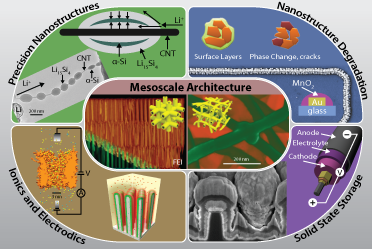
NEES EFRC Research Overview
To reveal scientific insights and design principles that enable a next-generation electrical energy storage technology based on dense mesoscale architectures of multifunctional nanostructures.
The Challenge
As demand for electrical energy storage (EES) reaches a critical point with increasing applications in transportation, grid storage and usage of renewable sources, energy research community seeks to develop new science and technology innovation to deliver high energy at high power levels over a sustainable time period.
Our Science Focus
Building on precision multicomponent nanostructures in densely packed architectures, NEES investigates mesoscale ion & electron transport behavior, science of dynamic nanostructure degradation addressing both short & long term time scales, and the science to enable solid state nanostructured batteries.
Our Goal
The Energy Frontier Research Center for Nanostructures for Electrical Energy Storage (NEES) will develop the science for and optimize the design of multifunctional nanostructures in 3-D mesoscale architectures that are applicable in EES.
The Impact
From model nanostructure architectures and their consequences in high power and energy storage, NEES seeks scientific insights into nanostructure electrochemistry to facilitate solutions for batteries that are safe and high in power and energy.
Phase 3: 2018-2020
For the 2018-2020 two-year extension research, NEES will be investing in directions that best leverage NEES capabilities and its uniqueness in structures and architectures, along with its leadership position in 3D solid state energy storage and design.
Thrust A
Interface Potentials, Reaction & Transport
Henry White (Utah, Thrust Leader), Sang Bok Lee (UMD, Deputy Director), Kevin Leung (SNL-NM), Janice Reutt-Robey (UMD)
Research activities include determining nanoscale chemical and voltage gradients across interfaces, characterizing interphase regions formed by reaction at solid electrolyte/electrode interfaces, and understanding how electronic structure (e.g. work function, electronic bandgap) of redox active materials evolves with dimensions, geometry, and mobile ion concentration.
Thrust B
Precision 3D Storage & Architecture
Alec Talin (SNL-CA, Thrust Leader), Bruce Dunn (UCLA), Gary Rubloff (UMD, Dir), Yue Qi (MichSt)
Research activities include demonstrating an integrated approach to design and computational modeling of 3D storage systems, validated and refined by experiments addressing electrochemical and mechanical properties, including developing characterization approaches to map the local voltage, composition, and stress gradients that are unique to the 3D architectures, particularly upon cycling.
Phase 1 & 2: 2009-2018
Thrust 1
Transport in Electrochemical Interphases
Goals:
- to measure, understand, and control ion and electron transport through interphases, especially using precision model nanostructures,
- to account for new effects in confined, mesostructured solids and liquids,
- to compare model systems against theoretical modeling.
Thrust 2
Mesoscale Architectures
Goals:
- to arrange precision nanostructures into hierarchical mesoscale architectures in both regular & random 3-D configurations,
- to model and categorize metrics for electrochemical reation of defined geometry of nanostructures,
- to understand how ion transport & dynamics is influenced by architectures at the mesoscale.
Thrust 3
Nanostructure Degradation Science
Goals:
- to identify intrinsic nanostructure degradation mechanisms during cycling,
- to sense degradation in ultralong horizontal nanowire arrays,
- to characterize the dynamics of degradation, addressing both early & extended-term time scales,
- To create predictive degradation models validated at the nanoscale.
Thrust 4
Solid State Energy Storage
Goals:
- to optimize solid electrolyte performance through atomic layer deposition (ALD) method,
- to construct 3-D nanobattery architecture & multiscale modeling through ordered/interdigitated or random scaffolds.
- to address consequences from ionics, electrodics and degradation phenomena in a 3-D solid state model system.